
December 3, 2025

Gabrielle T. Isaza, PhD
Senior Research Associate
Gabrielle T. Isaza, PhD
Senior Research Associate
In December 2020, the New Jersey Office of the Attorney General launched one of the most ambitious police use of force reform efforts in the nation. The goal: reduce use of force, enhance accountability, and promote professionalism in policing statewide.
The Use of Force Reduction Initiative included:
- Overhauling the statewide use of force policy,
- Standardizing use of force reporting through a systematic protocol and online dashboard, and
- Requiring all sworn officers, more than 31,000 personnel, to complete two use of force training programs.
Although supported by policymakers and community advocates, police reform efforts like this often lack strong scientific evidence on their impact. Even less is known about how to efficiently and effectively implement large-scale organizational police reforms, such as those undertaken in New Jersey.
Our Study
Recognizing this knowledge gap, we conducted a multi-year, multi-method research study to examine the New Jersey Use of Force Reduction Initiative. This study represents the first-of-its-kind research into statewide police use of force reform. It involved administering surveys to police officers across the state, conducting semi-structured interviews with training coordinators and law enforcement executives, and collecting and analyzing data related to the use of force and force-related injuries. The questions driving our research were:
- How did the officers perceive the mandated use of force training? Did the training shift their attitudes and perceptions?
- Did the reform initiative reduce police use of force and force-related injuries?
- Was the initiative implemented as intended? What were some of the obstacles to implementation, and how were they overcome?
The full findings of our study are presented across three reports (available here). Key takeaways from this research are summarized below.
Officers Perspectives on Mandated Training
All sworn officers in New Jersey participated in two use of force training programs: the Police Executive Research Forum’s Integrating Communications, Assessment, and Tactics (ICAT) de-escalation training and Georgetown University’s Active Bystandership for Law Enforcement (ABLE) peer intervention training. Six training surveys were used to assess officers’ experiences with the training and to determine whether the training had an impact on key attitudes and perceptions. The count of pre- and post-training survey responses ranged from 12,623 to 17,036 officer responses.
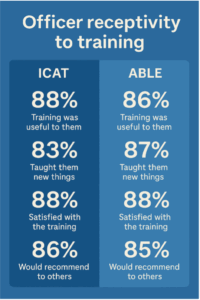 Despite being mandated, officers reported substantial receptivity to the training programs. Importantly, training receptivity measures have been shown to predict the use of training-related skills in the field.
Findings suggest that training in de-escalation and peer intervention can lead to changes in officers’ perceptions, promoting safe and effective community interactions.
- ABLE training improved officers’ perceptions of police misconduct, their attitudes toward peer intervention, and their self-reported likelihood of engaging in peer intervention.
- ICAT training improved officers’ attitudes on topics like use of force, interactions with community members, and responding to individuals in crisis.
Overall, we found that mandated use of force training can produce changes in officer perceptions and attitudes.
A Nuanced Story: Changes in Use of Force and Force-Related Injuries
Our research team analyzed use of force data from 2018 to 2024, assessing changes in use of force outcomes before and after the implementation of the Use of Force Reduction Initiative. Our analyses showed that the use of force did not consistently decline after the implementation of reform. Instead, impacts varied by outcome, location, and analytic strategy.
- In time series analyses, some agencies’ use of force counts decreased, others increased, but most stayed relatively stable over time.
- Looking at overall statewide counts, most short-term and medium-term crossover regression models showed no statistically significant changes.
- However, long-term crossover regressions indicated a statistically significant rise in total use of force.
Similar findings were observed for force-related injuries.
- When examining individual counties, descriptive analyses reveal that some regions experienced increases, while others experienced decreases.
- Note: We were unable to conduct time series analyses for force-related injuries at the agency level because the counts were too low.
- In statewide crossover models, there were no significant changes in force-related injuries for officers and subjects in the short- and medium-term models.
- However, we found significant increases in injuries for both groups in the long-term, full implementation models, just as we did with use of force counts.
We confirmed that the rise in injuries for officers and subjects aligned with the increase in total use of force counts.
Overall, use of force increased by about 9.5% from 2021 to 2024; however, arrests and serious offenses showed similar increases. This suggests that trends in use of force may be associated with an overall increase in police interactions with the public. New Jersey is not the only region experiencing recent increases in force-related outcomes. When looking at national trends, we found similar increases in use of force counts in four of the five largest American cities.
Importantly, our analysis shows that most agencies in New Jersey experience very few use of force incidents. We found that three out of four agencies in New Jersey had so few uses of force that detecting a statistically meaningful change over time is nearly impossible. It is unlikely that changes in use of force policy and training will create measurable changes in jurisdictions where officers’ use of force is already a rare event.
Lessons Learned from Implementation
Interviews with training coordinators and law enforcement leaders highlight the challenge of implementing statewide reform. Training coordinators reported logistical hurdles related to variation in training schedules, dosage, and coordination of scenario-based skill practice. It is unclear how variation in training delivery may have affected training experiences and outcomes, if at all, across jurisdictions.
Surveys and interviews with law enforcement leaders confirmed variability in implementation experiences and challenges. While many executives appreciated the reform goals, issues with implementation support and resource availability were common. Across all requirements, executives consistently reported that completing the mandated in-person training requirements was most difficult to achieve. Interviews also revealed that agencies must balance state mandates with their local priorities and resources, with factors such as agency size, leadership, and culture influencing implementation.
Looking Ahead: The Value of Targeting and Tailoring Reform Efforts
The evaluation of New Jersey’s statewide efforts to reduce use of force offers important lessons about the complexities of implementing uniform reforms across diverse policing contexts. While the initiative represented a comprehensive, evidence-informed approach combining mandatory training, standardized policies, and enhanced accountability measures, our findings reveal a nuanced picture of reform effectiveness that varies by agency context and implementation quality. These efforts produced several benefits:
- It was well received by law enforcement across the state,
- Led to measurable improvements in officer attitudes and perceptions to facilitate safe, effective interactions with community members,
- Instituted a critically important uniform use of force data collection system, and
- Helped to standardize the expectations for professional police interactions with the community.
However, this study emphasizes that agencies do not share the same risk of issues relating to the use of force. Structural and organizational elements should be considered to develop effective interventions. We recommend that future reform efforts focus interventions on high-risk locations to target the most at-risk places or agencies for force and related injuries. Additionally, interventions should be tailored to local contexts, using problem analysis to identify the factors contributing to issues around the use of force. These strategies can allocate resources more efficiently to support change.
For policymakers, the lesson is clear — progress isn’t always measured by clear declines, but by a deeper understanding of the context. The reforms did not uniformly reduce use of force, but they achieved other valuable changes: they fostered professional accountability, enhanced officer awareness, and established a transparent system for tracking force. These findings underscore the importance of thorough evaluation, transparent reporting, and ongoing collaboration to advance our understanding of what works in police reform.
Written by
Gabrielle T. Isaza, PhD
Senior Research Associate
Topic Area(s)
For general inquiries, please contact us at info@policefoundation.org.
Share
Strategic Priority Area(s)
Topic Area(s)
For general inquiries, please contact us at info@policefoundation.org
If you are interested in submitting an essay for inclusion in our OnPolicing blog, please contact Erica Richardson.
Share