
From large-scale political rallies to spontaneous community marches, the American tradition of protest has surged in both frequency and intensity over the past decade. These events are an essential expression of democracy — but they also present complex challenges for public safety. While the vast majority of demonstrations remain peaceful, research shows a measurable rise in politically motivated violence and First Amendment tensions since 2020 (RAND, 2024; NPI, 2022).
For law enforcement, this evolving environment is a crucible. Each critical incident or demonstration becomes a test of an agency’s ability to uphold constitutional rights while protecting both the public and officers. A well-planned, proportionate response can build credibility and community confidence. Conversely, a poorly managed one can erode trust, damage legitimacy, and leave lasting scars on both institutions and communities.
The National Policing Institute has long been at the forefront of helping agencies navigate these moments. Through independent reviews, training, and applied research, NPI works to ensure that every response — whether to a mass protest or critical incident — strengthens the bond between police and the people they serve.

The Research: What We Know About Protests and Critical Incidents
Recent studies underscore a central truth: most protests are peaceful. An ACLED study of over 2,400 demonstrations across the United States during the summer of 2020 found that there was no violence or destructive activity in 93% of them (ACLED, 2020). Yet the risk environment has intensified, with more frequent flashpoints around politically charged events and a growing potential for extremist violence (RAND, 2024).
How agencies handle First Amendment–protected events directly influences public perceptions of fairness, accountability, and restraint (NPI, 2022). Heavy-handed or inconsistent enforcement not only risks constitutional violations but can also deepen divisions between police and communities.
Planning, communication, and facilitation are the cornerstones of successful crowd management. When possible, agencies should engage protest organizers early, set clear behavioral expectations, and prioritize de-escalation (NPI, 2022)
Despite advances in crowd control methodologies, persistent evidence gaps remain. Few standardized systems exist for capturing protest-related data across jurisdictions. Long-term studies of community trust following large demonstrations are rare. And as new technologies — from drones to body-worn cameras — are integrated into protest response, the field still lacks robust evaluation of their ethical and operational impacts.
Where Agencies Struggle: Preparation and Accountability Gaps
Even as the research base expands, practice in the field often lags behind (NPI, 2022). NPI’s independent After-Action Reviews (AARs) — including assessments of major city demonstrations — reveal recurring challenges across agencies of all sizes.
- Incomplete or outdated protest response plans.
Many agencies rely on ad hoc procedures or outdated manuals that don’t reflect the realities of today’s political and social landscape (PERF, 2022). Without clearly defined command structures or mutual aid protocols, confusion and miscommunication can quickly escalate. - Limited scenario-based training.
While many agencies conduct some form of crowd control training, fewer engage in realistic, multidisciplinary exercises that simulate the full spectrum of modern demonstrations — including spontaneous gatherings, social media coordination, and the presence of multiple armed groups. - Insufficient First Amendment literacy.
Officers often receive minimal training on protest law (PERF, 2022). A lack of clarity on what constitutes “lawful assembly” or “disorderly conduct” can lead to inconsistent enforcement, undermining both legality and legitimacy. - Weak or absent After-Action processes.
Perhaps most concerning, many agencies still treat AARs as optional. Without formal reviews, opportunities for learning and accountability are lost. Independent reviews, like those conducted by NPI, not only identify operational improvements but also lend public credibility to an agency’s commitment to transparency (NPI, 2022).
How NPI Strengthens the Field
The National Policing Institute has played a central role in shaping how the profession learns from and prepares for critical incidents. Its approach is grounded in independence, evidence, and partnership with agencies across the country.
After-Action Reviews (AARs)
NPI has conducted some of the most comprehensive AARs in the nation, including the Independent Review of the LAPD’s 2020 Protest Response, which offered more than 80 actionable recommendations to strengthen planning, policy, and training. The NPI AAR Library — the first of its kind — curates findings from a variety of organizations across dozens of incidents, offering agencies a searchable knowledge base of lessons learned.
Guidance and Toolkits
Publications such as NPI’s 21st Century Protest Response: Promoting Democracy and Advancing Community and Officer Safety provide structured frameworks for balancing public order and constitutional rights.
Independent Reviews
By maintaining impartiality, NPI helps departments and cities rebuild public confidence after controversial events. Independent assessments not only identify operational failures but also validate what went right — reinforcing the principle that transparency supports legitimacy.
Training and Consultation
NPI offers tailored consulting on protest response planning, First Amendment policy development, and de-escalation training. This includes scenario-based workshops and executive briefings designed to bridge the gap between policy and practice.
Practical Steps for Agencies: From Policy to Practice
Based on NPI’s experience and research, several actionable steps stand out for agencies seeking to improve readiness and response:
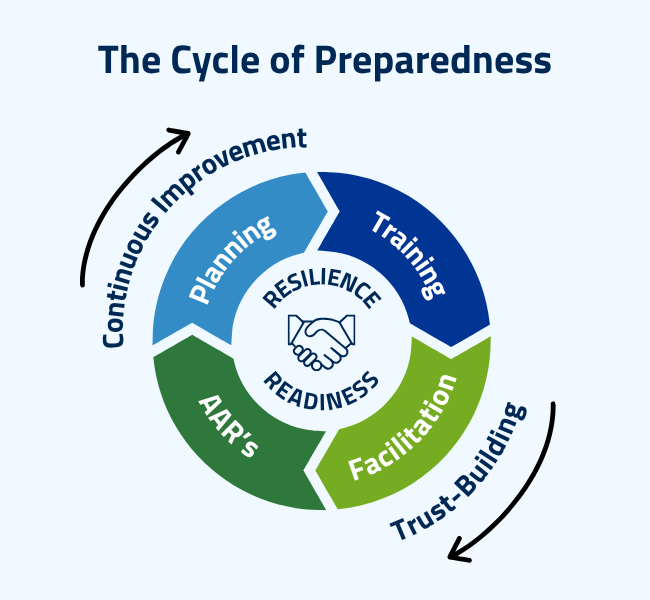
- Develop and regularly update protest response plans.
Incorporate clear command hierarchies, thresholds for tactical activation, and mutual aid procedures. Plans should be reviewed annually and exercised through table-top or full-scale scenarios. - Integrate First Amendment and de-escalation training into the core curriculum.
Officers and supervisors should understand the nuances of protest law, emphasizing facilitation of lawful assembly over enforcement-first approaches. - Adopt proportionate, facilitative tactics.
Emphasize communication and flexibility. Engage protest organizers before events and clearly distinguish between peaceful demonstrators and those committing violence or serious crimes. - Institutionalize independent After-Action Reviews.
Every major incident — whether successful or problematic — should trigger an AAR. Sharing lessons publicly demonstrates accountability and advances the profession’s collective knowledge.
Invest in community partnerships before crises occur.
Build relationships with civic and advocacy groups proactively. Trust built in calm times pays dividends when tensions rise.
The Human Element: Restraint, Respect, and Resilience
Technology, tactics, and training matter — but so does mindset. Agencies that view protests not as disruptions but as democratic expressions are better positioned to manage them effectively. Research has shown that facilitative policing — emphasizing communication, empathy, and restraint — reduces confrontation and improves public perception (Maguire, 2016).
Restraint, however, must be underpinned by preparation. Officers under stress revert to their training; if that training emphasizes escalation control and constitutional literacy, they are more likely to respond proportionately. Leadership, too, plays a defining role. Transparent communication from command staff before, during, and after incidents sets the tone for accountability and public confidence.
A Path Forward: Building Institutional Legitimacy Through Learning
Critical incidents and mass demonstrations will continue to test the profession. The question is not if they occur, but how agencies respond.
Preparedness is no longer a static checklist — it is a mindset rooted in learning, accountability, and partnership. Through independent reviews, evidence-based tools, and a commitment to transparency, NPI continues to help agencies turn crisis into opportunity.
By investing in planning, embracing restraint, and learning from every incident, law enforcement can strengthen not just their operational capacity, but their social contract with the communities they serve. The path forward begins — and endures — with trust.
References
NPI Publications & Resources
- National Policing Institute. After-Action Review Library.
- National Policing Institute. How to Conduct an After-Action Review.
- National Policing Institute and COPS Office. 21st Century Protest Response: Promoting Democracy and Advancing Community and Officer Safety (2022).
- National Policing Institute. A Crisis of Trust: Independent Review of LAPD Response to 2020 Protests (2021).
Other Research-Based Sources
- Armed Conflict Location and Event Data. Demonstrations and Political Violence in America: New Data for Summer 2020 (2020).
- Maguire, Edward R. New Directions in Protest Policing (2016).
- RAND Corporation. On Reducing Public Fears and Threats of Political Violence (2024).
- Police Executive Research Forum (PERF). Managing Major Events: Best Practices from the Field (2011).
Police Executive Research Forum (PERF). Rethinking the Police Response to Mass Demonstrations: 9 Recommendations (2022).
Never miss an issue of InFocus
Share