
The public has said what would earn its support: safeguards first, backed by communication that is sustained, factual, and tied to results. The lesson reaches well beyond license plate readers, to every technology or strategy the public is asked to trust and fund.
The Big Picture
Many leaders are responding to the license plate reader backlash by doing what anyone would expect: explaining the value of the technology and how it has helped. They are right that communication matters, but our data suggest the kind of communication matters more. A single message about benefits did little to change overall support. The public’s views are often tied to what it has seen or believes goes wrong, and it wants safeguards and governance, confirmed through communication that is sustained and factual. Communication without safeguards does not respond to what the public has told us matters most.
In last month’s InFocus, we addressed why the backlash against automated license plate readers (ALPRs) has more to do with governance than technology. Earlier this month, we published an independent national survey of public attitudes toward ALPR use. The headline number, 54.4% of Americans opposed to police license plate readers in their community, has been widely reported.
But since then, one response keeps coming up in conversations with leaders: “we just need to do a better job of communicating and educating the public.” That view is understandable when you know that there is value at stake, but the data illuminate what we can’t overlook. A single message did not change overall support for ALPRs, but it did move some people choosing “end the program” to keeping it with restrictions. This is an opportunity and a sign that communication must be sustained and backed by safeguards.
Since our report was released, NPI’s supplemental analysis of the survey data confirms three things more clearly. The public’s views on what should happen are nearly identical across politics and demographics (age and race). The public’s views often come from specific incidents people have become aware of, not only general unease about privacy or security. And a single accurate message, tested directly, did not build overall support for ALPRs. It pulled some back from wanting a program ended entirely, but it did not move people toward greater approval of ALPR use. Together, these findings point to a way forward for technologies now and in the future: safeguards and clear limits on use first, with communication that is sustained, factual, and reflective of the safeguards.
The public knows what it wants, and most groups want the same thing
We asked respondents what their community’s law enforcement agency should do with an existing program. 44.8% of respondents said continue it with new restrictions, 15.6% said continue as is, and 33.2% said end it. This is important, and it differs from the reels and posts of social media. A majority (6 in 10) wants the program to continue in some form. More than three-quarters want something to change. A third wants the cameras gone.
Respondents were asked to choose up to three measures that would most increase their support for license plate reader programs. Three rose to the top: independent audits by someone outside the department (41.8%), a documented case number and reason for every search (36.1%), and regular public reports on how the data were used (34.2%). A public dashboard (27.9%) and warrant or supervisor approval before searches (27.5%) followed.
NPI’s supplemental analysis reveals how little that list changes from group to group. We examined sixteen demographic and political groups. Fourteen of them chose the same top three. Two did not. Adults 18 to 24 put public reports first, ahead of audits. Very liberal respondents put a ban on immigration enforcement use first, followed by a warrant requirement. The demographics in your community will matter.
Respondents were then asked how their support would change if their department adopted the safeguards they had just chosen. A majority (57.5%) said it would increase, and 2.9% said it would decrease. In nearly every demographic group we surveyed, half or more of respondents said their support would rise. Notably, roughly seven in ten Black respondents, 65% of liberals, and 62% of conservatives said support would rise. Very liberal respondents were lowest at 43%, though this is still a substantial percentage.
Respondents were just as clear about data retention. Just over half (53.2%) said data on vehicles not connected to a crime should be kept for 30 days or less, and 21.3% said it should not be collected at all. Only 3.7% accepted keeping it for more than a year. On reporting, 90.6% wanted a public report at least quarterly.
Those views come from exposure and experiences
The survey asked whether anything specific in the past year, such as something that happened to them or something they read, had shaped how respondents felt about these cameras. Of the 1,435 respondents, 389 responded to the question. These are the people motivated enough to write, so the themes show what drives strong views, not how common each experience is in the population.
The largest theme by a wide margin was concern about officers misusing access for personal reasons (about 165 mentions). Many of these cited learning about allegations or findings of officers tracking a current or former partner.
Next came wrongful stops, misidentification, and reader errors (about 86 mentions), including accounts of plate misreads that led to stops of families, including felony stops. General surveillance and privacy concerns followed (about 78). Concern about immigration enforcement drew about 26. About 25 respondents described something positive, usually a recovered vehicle, a solved homicide, or a missing person found. Smaller numbers of respondents mentioned cameras appearing nearby, data breaches and third-party sharing, and cameras used to track travel for abortions.
These themes are not disconnected from the safeguards the respondents chose. Audits, documentation, transparency, limited use cases, limited sharing, and limited retention arguably could address the concerns.
That match explains why a message cannot do what a safeguard does. A message tells people that these things are relatively rare or that there are more successes than problems. A safeguard prevents and responds to the problems. People who have read about misuse involving tracking an ex-partner are not asking to be reassured. They are asking for the control that will prevent it or provide accountability.
A single message is not a communication strategy
The survey tested whether communication changes views. Before the final policy questions, one-third of respondents read an accurate positive statement about the cameras (recovered vehicles, missing persons located, vehicles connected to shootings), one-third read an accurate negative statement (long-term retention, sharing with other agencies, documented misuse), and one-third read neither. Neither statement changed overall opinion by a significant amount, regardless of how much respondents had heard about ALPRs before. The positive statement led noticeably fewer people to choose “end the program” (about 27% versus 38% with no message). Most of that shift went to “continue with new restrictions,” not to “keep as is. A well-made safety case may help a program survive a shutdown vote, but it did not reduce the demand for change. The test was a single exposure, competing with news and social media coverage that is constant and largely critical.
What the survey did not test is sustained communication: regular, factual reporting that starts before launch, confirms the safeguards and audit results, and connects the technology to results the public cares about, such as recovering missing and abducted persons and responding quickly and effectively to violent crimes. People the technology has helped, prosecutors who use the evidence in court, and others like them are likely to carry more weight than those with a vested interest. But even the best communication likely cannot substitute for safeguards in this case. Its job is to show the public that the safeguards exist and are working and the technology is doing what they’d expect it to do.
Use cases matter…a lot
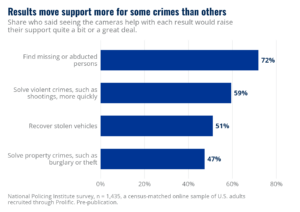
Safeguards work within the limits an agency sets on the system’s purpose, and neither works alone. Most respondents accept using the cameras to find missing or abducted children (88.3%) and to investigate violent crime (83.6%). Acceptance falls to 22.0% for general ongoing monitoring, 25.8% for routine traffic enforcement, 26.4% for immigration enforcement, and 17.7% for monitoring protests. That 70.6-point spread is wider than the gaps between political groups. The public supports the uses agencies most often cite, such as finding missing children, solving violent crimes, and recovering stolen cars, but has less support for other uses the technology makes possible. Our supplemental analysis reveals that seeing how ALPRs help with use cases such as finding missing and abducted persons or solving violent crimes such as shootings more quickly would raise respondents’ support quite a bit or a great deal, as shown in Figure 1 below. Routine reporting on those results can build that support.
Figure 1
Deciding what the system will and will not be used for is the first governance decision. The audit, search documentation, and public reporting then confirm that the agency is keeping to those decisions and doing so with assurance and accountability, with safeguards working to prevent problems and address concerns.
What Agencies Can Do Now
Decide which safeguards are right for your community. The public’s list is short and consistent: independent audits, a documented reason for every search, public reporting, and short retention. An independent audit means someone outside the department sets the scope, sees the query logs, and writes the findings. Documentation of queries should be validated, and questions may arise about who in the agency should be able to query. Being transparent with ALPR data extends to being transparent with audit findings.
Focus on the uses your community supports. Support for the cameras varies widely by use case, and it matters who has access to the data. Limiting use to accepted purposes and scrutinizing data-sharing policies and practices, particularly for unsupported use cases and with agencies that may have different or no safeguards, could build support beyond what the safeguards bring.
Treat the safeguards as a package. The 57.5% who said their support would rise were responding to the set of up to three measures they chose, not to a single item. The survey did not test safeguards one at a time. An agency that adopts one without others may continue to struggle for support.
Listen and acknowledge before defending. The concerns respondents described are specific, and many match documented cases. It is important to connect your safeguards to these concerns and to share what the tool does when it is well governed, using your own numbers.
Establish intentional data collection and report routinely on safeguards and results, and let others help tell the story. Agree with your community and elected officials on how success will be measured, then publish use, results, and audit findings on a regular schedule, including shortfalls. Invite prosecutors, crime victims, and residents the tool has helped to speak about it.
Engage the community on the safeguards and remember that the loudest voices on either side of this may not represent all voices. Use local surveys, small-group sessions, and community organizations residents already trust to get additional input and share your perspective.
Pay particular attention to young adults. Age divides respondents more than race or sex. Opposition runs 67.6% among adults 25 to 34, compared with 40.6% among those 65 and over, and adults 18 to 24 rank public reporting above independent audits, so publish reports where they will see them. In a companion piece in NPI’s OnPolicing blog series, Elina Jadhav, a talented and thoughtful young leader, notes that young people are usually given a chance to comment only after a technology decision has been made. Her article highlights the importance of consultation before adoption and offers an example relevant to this discussion.
A lesson for every new technology
The survey asked about five other technologies. Gunshot detection sensors drew 66.0% support, the only one with majority support, while facial recognition with public cameras came last at 22.6%. License plate readers sat in the middle. Respondents appear to sort technologies by how far each one goes in identifying individuals, not by hostility to police technology in general. The same framework applies to drones, real-time crime centers, and facial recognition: define the purpose, document the reason, audit independently, report publicly, and keep data on those who appear to be uninvolved only long enough to confirm that, if at all.
This isn’t new. In 2014, George Mason University scholars Koper, Lum, and Willis urged that “police managers should do more to systematically track the ways that new technologies are used and the outcomes of those uses,” noting that license plate readers were “typically deployed with no systematic tracking of how they are being used and with what results.” That tracking is the foundation for everything above. It gives auditors something to check, public reports something to say, and leaders evidence of the tool’s value when it is questioned. Defining the purpose, building in safeguards, tracking use and results, and reporting them publicly is the responsible way to implement any new technology, not only ALPR.
The Bottom Line
The public has thought about license plate readers and said what would fix it. Most respondents want the program to continue, and the largest group wants it to continue with new restrictions. A third want it gone.
The data do not support the idea that a better message alone will resolve this. A single message may help a program survive long enough to be fixed. What rebuilds confidence is the combination the public described: clear limits on use, safeguards, and regular, factual reporting that shows the safeguards are working. Communication matters, but without safeguards behind it, it does not answer what a wide swath of the public wants to see. Leaders who are prepared to accept safeguards and clearly defined use cases may be in the best position to keep the tool and rebuild confidence. Leaders who are not should ask whether the program can be sustained. And every leader should ask these questions about the next technology before signing on the dotted line.
Need assistance? If your agency is reviewing its license plate reader program, weighing safeguards, or preparing for a council discussion, NPI can help, including planning, implementation, and evaluation support for new technologies. Contact NPI.
References
Burch, J. (2026, September 15). Survey: Public support for ALPRs hinges on purpose and safeguards. Police1. https://www.police1.com/alprs-in-focus/survey-public-support-for-alprs-hinges-on-purpose-and-safeguards
Jadhav, E. (2026). Involving communities and youth in police AI adoption. National Policing Institute.
https://www.policinginstitute.org/onpolicing/involving-communities-and-youth-in-police-technology-adoption/
Koper, C. S., Lum, C., & Willis, J. J. (2014). Optimizing the use of technology in policing: Results and implications from a multi-site study of the social, organizational, and behavioural aspects of implementing police technologies. Policing: A Journal of Policy and Practice, 8(2), 212–221.
National Policing Institute. (2026a, August 27). ALPR backlash: What agencies need to know. https://www.policinginstitute.org/infocus/alpr-backlash-what-agencies-need-to-know/
National Policing Institute. (2026b). What the public thinks about license plate readers: Findings from an independent national survey. Arlington, VA. https://pages.policinginstitute.org/public-opinion-on-license-plate-readers-alpr-survey
National Policing Institute. (2026c). Supplemental analysis of the national ALPR survey: Messaging effects, group differences, and open-ended responses. Arlington, VA. [unpublished]
Disclosure: NPI has developed an approach to independent review and assessment of ALPR programs and data use and has begun to offer this service.
Never miss an issue of InFocus
Share