
March 12, 2026

Travis Taniguchi, PhD
Katherine Hoogesteyn, PhD

Eiryn Renouard
Travis Taniguchi, PhD
Katherine Hoogesteyn, PhD
Eiryn Renouard
Dean Esserman, JD
In recent years, ghost guns (also known as privately made or unserialized firearms) have become a significant concern to law enforcement and public safety. The term “ghost gun” encompasses a variety of firearms produced from components that are not currently regulated by federal firearm laws. Most commonly, ghost guns are produced from components purchased (generally online) from businesses and individuals that most often include nearly finished aluminum or polymer frames or receivers (also known as 80% lowers or 80% build kits).1 These components and kits are specifically designed and marketed to be converted into fully functional firearms using only basic hand tools (Wintemute, 2021).
Three less common approaches to producing ghost guns exist. First, recent advancements in at-home 3D-printing technology have enabled people to produce fully functional firearms using readily available online plans (Jacobs & Haberman, 2017). Second, computer numerically controlled (CNC) milling machines can be used to transform metal blanks into firearm receivers. Although this has been possible with traditional CNC mills, recent developments have produced lower-cost, at-home mills specifically for manufacturing AR-15 receivers. Finally, liquid resincasting kits, which include reusable molds and high-strength polymer, have been developed to produce AR-15 lowers at home.
Historically, technical barriers to firearms manufacturing meant that doing so was relatively rare and its impact on public safety and firearm-related violence was low. However, recent advances in ghost gun production have reduced the barrier-to-entry and made home production of fully functional firearms a feasible task for less technical users (Zezima, 2018). The unlicensed production and unregulated nature of the core components parts used to build ghost guns make it impossible to know how many untraceable functional firearms are created every day. The gun lobby likens the at-home production of ghost guns to other hobbies, such as building a car (Zezima, 2018). Public safety and gun violence prevention advocates cite the growing representation of ghost guns in crime, as well as the ease of production, lack of background checks, and poor traceability, as reasons that ghost gun components and kits should be regulated like all other firearms.
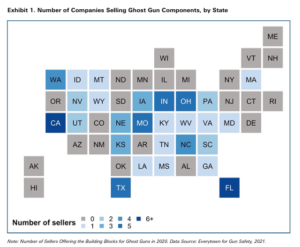
The sizable commercial market for ghost gun components and kits (Exhibit 1) and proliferation of operable ghost guns has made it difficult for law enforcement agencies (LEAs) to enforce firearm laws, trace unserialized firearms found at crime scenes, and track people who have used them in crimes.
Existing academic research on ghost guns has tended to focus on the legal and regulatory framework that may influence ghost gun kit and component manufacturing and sale. Media coverage, on the other hand, has largely described the use of ghost guns in events such as mass shootings or use by extremist groups. For example, the Santa Clarita Saugus High School shooter reportedly used a ghost gun to kill two students and wound three others (Stephens, 2019b). In 2020, the Oakland shooter connected to the far-right wing Boogaloo Movement, ambushed law enforcement officers with an AR-15 from a ghost gun kit (Beer, 2020). Despite increasing data on ghost guns used in crime, vigorous debate over ghost gun regulations, and growing media coverage and national interest, there has been little research to understand how LEAs are responding to the proliferation of ghost guns or to the full extent of the impact ghost guns have had on public safety. In this study, we addressed current knowledge gaps regarding LEAs’ experience with ghost guns to provide a national overview of current perceptions, practices, and recommendations for improving public policy.
Interviews with command, patrol, forensics, and specialized units [e.g., Crime Gun Intelligence Centers (CGICs), Firearms Examination Units (FEUs)] from 24 LEAs revealed that agencies’ level of awareness and planning for ghost guns grew as their rate of recoveries increased. Recoveries were more prevalent in high-population cities, such as Los Angeles, Philadelphia, and New York, while small to mid-sized cities, such as Spokane, Wichita, and Madison, recovered fewer. Participants believed that stricter gun laws in California and East Coast states contributed to the proliferation of ghost guns in those areas compared to the Midwest, where the barriers to purchase for those who legally cannot, such as those who have committed crimes and prohibited individuals, are less significant.
Participants from several LEAs in states with strict gun laws reported that ghost guns were primarily recovered from individuals prohibited from possessing firearms. Reliable information about the use of ghost guns in crime and firearm-related injuries was inconsistently collected and reported across LEAs. Whilst several agencies described collaboration with local agencies and the Bureau of Alcohol, Tobacco, Firearms, and Explosives (ATF), most agencies had not taken formal steps to track these data. Inconsistencies around the procedures to collect and report these data make it difficult to estimate the national prevalence of crime-involved ghost guns. Moreover, LEAs noted the need for national identification and reporting standards.
Several officials indicated that they believed it likely that not all ghost guns had been correctly identified. Policy recommendations based on this research include halting the proliferation of ghost guns through regulating the production and sale of ghost gun components and kits by updating the outdated definition of firearm. Recommendations for improvements on the process of tracking and reporting ghost gun data, training, within-agency information sharing, and research are also discussed.
BACKGROUND
Ghost guns refer to a wide range of homemade or improvised firearms that do not have serial numbers. Most prominent in current public discourse are ghost guns made from 80% kits or via 3D printing. These components are often called 80% kits because they contain an unassembled set of the components of a functioning firearm, generally lower receivers with an unmachined fire-control cavity area and no holes or dents for the selector, trigger, or hammer pins (ATF 2020; Fletcher, 2020). The nearly complete frames and receivers included in the kits, or sold separately, are the core component parts that are key to building a ghost gun. The framework for regulating these unassembled components is currently under revision and subject to ongoing litigation. Under ATF’s current interpretation of federal law, the incomplete nature of component parts means that they do not meet the definition of a firearm (Allen, 2019). Purchasers of these incomplete receivers complete basic machining to make the frame or receiver operable, acquire additional required components, and assemble all the components to finish the firearm. However, when components are combined and sold as a kit (typically including an unfinished receiver, slide, barrel, and other mechanical assemblies), they may be considered a firearm for regulation purposes.
From a public safety perspective, ghost guns pose three challenges. First, because the components are sold unassembled and require some additional milling to be assembled, the components have been interpreted by the ATF to not meet the legal definition of a firearm. Because of this, purchasers are not required to undergo a background check. Second, and because they are not treated as firearm sales, sales of ghost gun kits are not dealer sales records recorded. Finally, because they are not considered firearms at the time of sale, the manufacturer is not required to affix markings typically required by law, including a serial number and name of the manufacturer, of a fully functional firearm. The lack of serial number makes it difficult for LEAs to reliably track and investigate ghost guns that have been recovered in crime.
Depending on state-specific laws, a serial number may be required at the time the purchaser goes on to register the completed firearm, but it is unclear to what extent purchasers follow through with registration or serializing the firearm. For example, California’s 2018 ghost gun legislation4 required all self-assembled firearms to be engraved with a unique serial number from the California Department of Justice. Violation of this legislation resulted in punishment of six to 12 months of imprisonment or a fine of up to 1,000 USD. However, recent sources estimate that almost half of the guns recovered by ATF in Los Angeles are unserialized ghost guns (Hitt, 2020), calling into question the effectiveness of ghost gun regulations that depend on purchasers’ own motivation to follow through with serialization, especially when punishment remains at a misdemeanor level (Beyer, 2014; Doherty, 2021).
Regulation of firearms produced through commercially available 3D printers using computer-assisted design (CAD) blueprints that are shared or sold online, can be even more complex. 3D-printed firearms made from metal started appearing in 2013, however, most are still made entirely from plastic, which makes them undetectable by metal detectors (Beyer, 2014). Efforts to regulate the distribution of 3D-printed firearm CAD files has been challenging. Producers have argued that the distribution of these files is a form of protected speech. Jurisdiction over these CAD files has moved from the Department of State to the Commerce Department, and while the Commerce Department has articulated guidance to limit the proliferation of the CAD files, the distribution of CAD files that facilitate the production of firearms remains unclear.
GHOST GUNS IN THE MEDIA
Law enforcement recovery of ghost guns have been reported across the country, but media coverage has predominantly focused on Washington, DC, California, and New York, possibly because these jurisdictions have ghost gun regulations and therefore have greater experience with recognizing ghost gun recoveries by LEAs. In particular, California has seen a considerable number of crime-involved ghost guns (e.g., Allyn, 2021; Andone, 2019; Blankstein & Siemaszko, 2017; Engel, 2013). Nearly 30% of all guns recovered by ATF agents in California were unserialized (Stephens, 2019a). Additionally, cities throughout California have seen significant increases in ghost gun recoveries in recent years. San Diego saw a 940% increase in recoveries from 2017 to 2018. During the same time frame, Oceanside saw a 280% increase, and San Jose saw a 51% increase (Stephens, 2019a). On the East Coast, Syracuse reported a 30% increase in ghost gun recoveries between July 2019 and July 2020 (Baker, 2020). Washington, D.C.’s Metropolitan Police Department reported a 360% increase in recoveries between 2018 and 2019 (Gomez, 2020). The Baltimore Police Department reported a 334% increase in recoveries between 2019 and 2020 (Gaskill, 2021). Other agencies have provided recovery information by year, or for several years. Philadelphia Police Department recovered 118 ghost guns in 2019, Prince George’s County (MD) Police Department recovered 63 in 2019, and Montgomery County (MD) Police Department recovered more than 70 in 2020 (Grimshaw, 2021).
GHOST GUN REGULATIONS
Federal and state legislation around the control of ghost gun components and kits are rapidly evolving; changes at both state and federal levels were implemented just during the time this research was being conducted. In this section, we provide an overview of legislation implemented to regulate different aspects of ghost guns. We note that a comprehensive legal analysis was outside the scope of this work and recommend other sources for a more thorough discussion of state and federal regulations (for example, see Everytown for Gun Safety, 2021).
FEDERAL FIREARMS REGULATIONS
Federal firearms regulations have not fully caught up to the public safety risk created by ghost guns. The Gun Control Act of 1968 regulates interstate firearm commerce of Title I firearms. Under the Gun Control Act, persons engaged in the business of manufacturing, importing, or dealing firearms must obtain a license from ATF. The Gun Control Act was amended by the Brady Handgun Violence Prevention Act and mandates federal background checks for firearms purchased from licensed firearms dealers. Although strongly debated, some legal scholars, such as Beyer (2014) have argued that, because neither Act mentions firearms made for personal use, it can be assumed that assembling a firearm at home for personal use would not be subject to either Act.
Two other statues are generally also interpreted as regulating ghost guns. The National Firearms Act (NFA) defines and regulates Title II firearms6 regardless of intended use or assembly method. Title II firearms must be registered with the National Firearms Registration and Transfer Record. Although the NFA does not specifically mention ghost guns, personally made firearms that meet the Title II definition of a firearm are regulated and must be registered. Additionally, the Undetectable Firearms Act, extended in 2013, requires firearms to contain sufficient metal that, after the removal of grips, stocks, and magazines, can be picked up by a metal detector. Thus, ghost guns made without sufficient metallic content, most likely produced with 3D printing, would be illegal regardless of how it was made.
Within existing case law, courts have rejected Second Amendment challenges of certain firearm regulations where adequate alternatives remain for law-abiding citizens to acquire a firearm or ammunition for self-defense and the challenged regulation was sufficiently related to a substantial government interest. A federal appellate case held that there was no constitutional right to owning an unserialized gun. As the U.S. Court of Appeals for the Third Circuit observed in upholding the federal prohibition on possession of firearms with obliterated serial numbers, “[b]ecause the presence of a serial number does not impair the use or functioning of a weapon in any way, the burden on [an individual’s] ability to defend himself is arguably de minimis…. [A] person is just as capable of defending himself with a marked firearm as with an unmarked firearm.”11 Moreover, “[f]irearms without serial numbers are of particular value to those engaged in illicit activity because the absence of serial numbers helps shield recovered firearms and their possessors from identification.”
STATE-LEVEL RESPONSES TO GHOST GUNS
The landscape of ghost gun legislation at the state level is complex and rapidly evolving. Ten states have enacted legislation to regulate at least some aspects of ghost guns: California (2016), Connecticut (2019), Hawaii (2020), Massachusetts (2019),Nevada (2021), New Jersey (2018), New York (2019), Rhode Island (2020), Virginia (2004), and Washington (2019).
California, Connecticut, New Jersey, New York, Rhode Island, and Washington prohibit the manufacturing of undetectable firearms, requiring that the major components of firearms be detectable with a metal detector. Virginia and Massachusetts regulate possession of these undetectable firearms.
California, Connecticut, and New Jersey require that ghost guns be registered and marked with a serial number. Hawaii and New Jersey banned unlicensed manufacturers from purchasing or assembling ghost guns; Connecticut requires ghost guns to be serialized. The District of Columbia passed emergency legislation in March 2020 banning the sale of unassembled ghost guns kits and components, or the building of a functional firearm from these parts within the District (Hermann, 2020). Rhode Island recently passed broad legislation stating: “No person shall manufacture, sell, offer to sell, transfer, purchase, possess, or have under his or her control a ghost gun or an undetectable firearm or any firearm produced by a 3D-printing process.”
In June 2021, New York State Senate and Assembly passed two additional bills to further regulate ghost guns. They would prohibit the possession and sale of unfinished frames and receivers by unlicensed individuals, criminalize the sale of ghost guns, and require gunsmiths to register and serialize ghost guns they assemble. At the time of publication, these bills await the Governor’s signature. Effective in January 2022, and subject to ongoing legal challenges, Nevada’s Assembly Bill 286 would prohibit “a person from possessing, purchasing, transporting or receiving an unfinished frame or receiver…” that has not been given a serial number.
Despite the implementation of these regulations, and the public safety implications, there is little research exploring the ability of state legislation to effectively regulate the production and ownership of ghost guns (Beyer, 2014; Doherty, 2021). Compliance with these registration requirements appears low and, in California for example, no charges have been brought against those that have failed to register.
Two issues have limited the ability to determine the effectiveness of state-level ghost gun regulatory efforts. First, research has been hampered by the lack of data on ghost gun kit and component production, sales and registrations, and recoveries by LEAs. Systematically exploring the impact of legislation will be impossible until more reliable information is available. Second, many state-level laws fail to address all issues associated with ghost gun production and manufacture. For example, California requires that ghost guns bear a unique serial number but the law regulating the sale of ghost gun precursor parts does not go into effect until July 2022.
ATF RESPONSE TO GHOST GUNS
In August 2020, San Jose, Chicago, Syracuse, and Columbia—with the help of Everytown for Gun Safety—filed a lawsuit against the Justice Department and ATF to “stop the proliferation of what are advertised as easy-to-assemble guns that require no serial numbers or background checks” (Associated Press, 2020). The lawsuit called for the ATF to expand the definition of firearms to include core components of firearms, therefore requiring sellers engaged in the business to be licensed and for there to be background checks and serial numbers with any sale. The four cities and Everytown cited concern for public safety risks, increasing gun crime, and firearm trafficking as the primary motivators behind the lawsuit (Everytown Law, 2020). On April 7, 2021, President Joe Biden announced that within 30 days, the Justice Department would issue a proposed rule to stop the proliferation of ghost guns. On May 7, 2021, ATF responded and proposed regulations to update outdated firearms definitions that will require manufacturers and retailers to become licensed and follow applicable regulations, including the requirement to run background checks before selling an 80% kit and require manufacturers to assign each kit a serial number on their frame or receiver (Zapotosky, 2021). The proposed rule achieves this by clarifying the regulatory definition of firearm to include nearly complete frames or receivers that are either designed to be part of a functioning firearm or could easily be turned into one (Everytown for Gun Safety, 2021). If adopted, the rules would require dealers and gunsmiths (licensees) to apply a serial number to ghost guns. Licenses would be required to update their acquisition entries with information marked on the ghost guns.
KNOWLEDGE GAPS
Public awareness about the risk posed by ghost guns is growing. However, there are considerable gaps in knowledge about the proliferation of ghost guns and how LEAs address the growing presence of crime-involved ghost guns. The unregulated and untraceable nature of ghost guns, coupled with rapidly growing rates of recovery, may pose significant challenges to agencies’ ability to appropriately identify, track, process, and investigate ghost guns. Moreover, whilst the nature of ghost guns renders LEAs usual methods for handling firearms less effective, currently there exists little training and guidance for collecting, tracking, and reporting ghost guns and their data. There is also little insight into if and how agencies are communicating with each other regarding ghost guns, and how the tracking and reporting processes and gaps differ from region to region and state to state. In this study, we addressed current knowledge gaps regarding LEAs’ experience with ghost guns to provide a national overview of current perceptions, practices, and recommendations for improving public policy.
METHODS
NPI conducted interviews with command staff, officers from patrol divisions, members of specialized units (e.g., CGICs, Firearms Examination Units, Gun Violence Task Forces), and forensics staff from 24 agencies to understand how different types of agencies, and staff with varying roles within agencies, have experienced and addressed the issue of ghost guns. Agencies were intentionally varied by geographic region, agency type, agency size, and experience with ghost guns recoveries and crime-involved ghost guns. Interviews took place between February and July 2021. All interviews were conducted online via video conference by one main interviewer and assisted by a notetaker. Interviews were structured and followed a schedule with pre-determined queries regarding the agencies’ level of awareness regarding ghost guns, number of recoveries and in connection to what sort of events had (if any) tracking and processing procedures in place, policies specific to the handling of ghost guns, etc.
RESULTS
All the agencies and staff interviewed, except two, reported encountering at least one ghost gun since they began tracking their recoveries. Most agencies began tracking ghost gun recoveries between 2016-2020, while one agency reported their first ghost gun recovery as early as 2015. Agencies that reported higher levels of ghost gun recoveries were primarily located in California and the East Coast. LEAs in other regions tended to report fewer ghost gun recoveries. Most agencies that have tracked ghost gun recoveries over time show a significant increase in recoveries year after year.
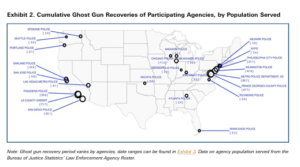
High-population cities, such as Los Angeles, Philadelphia, and New York have seen more ghost gun recoveries, while small to mid-sized cities, such as Spokane, Wichita, and Madison, saw fewer any kind of new technology being used by the criminal element, the Midwest is always behind.” Notably, several agency representatives believed ghost guns to be less prevalent where the acquisition of traditionally manufactured firearms was easier or less restrictive for those who have committed crimes and prohibited individuals; a forensic examiner from the
Cincinnati Police Department stated:
“There is no market for them here. We had a mass shooting a couple of years ago, and the guy that committed it had purchased the gun two weeks prior on a local website. We have such a proliferation of firearms in the area that we don’t have experience with [ghost guns] used in crimes. [There are] well over 20-gun stores in Cincinnati area… I think that’s why we are behind on ghost guns. “
By contrast, the state of California, which has more restrictive gun laws, has experienced a higher volume of ghost gun recoveries and crime-involved ghost guns. Oakland Police Department’s Chief Armstrong stated, “We are beginning to see them more frequently, and have even heard from community members that ghost guns are being sold openly in the community.”
For LEAs that have recovered ghost guns, nearly all had been assembled using nearly complete frames/receivers. Interviewees reported that Polymer80 was the most common brand of ghost guns identified; it was specifically named in all interviews with agencies that had made at least one recovery. Interviewees identified other brands including James Madison Tactical and Strike Industries. According to the interviews, most recovered ghost guns were modeled after Glocks, 1911s, or SIG Sauer. LEAs reported between 70-100% of their ghost gun recoveries to consist of handguns (as opposed to long guns). No LEAs reported having routine recovery of 3D-printed ghost guns; only a few, including San Jose and New York City Police Departments, described encountering them.
Prince George’s County Police Department reported the most experience with 3D-printed ghost guns (seven recoveries as of mid-2021); staff believed them to be a serious emerging problem. According to a Prince George’s County Police Department’s forensic firearm examiner, they had encountered 3D-printed items in two primary forms: pistol frames (receivers), which are fitted with additional parts to make functioning semiautomatic pistols, and selector switches for Glock and Glock-style pistols. The examiner further noted that examiners in Washington, DC, had also received 3D-printed firearms, and an information-sharing agreement has been established to address this problem.
When asked if they considered ghost guns to be a serious concern, LEAs with a higher number of recoveries tended to consider them a growing concern compared to agencies with less exposure. For example, after the Saugus High School shooting in 2019, Los Angeles and San Jose Police Departments began taking ghost guns very seriously. The Pasadena Police Department began considering ghost guns as a serious concern in the Summer of 2020 when “recovering ghost guns started to be almost a daily occurrence.”
By contrast, due to their small number of recoveries, the Richmond Police Department saw ghost guns as a serious concern “in theory but not in practice”, although they acknowledged that they could see the issue growing more serious as the awareness of ghost guns increased among gun traffickers. The growing concerns LEAs reported corresponds with the escalation in ghost gun recoveries some agencies are experiencing. Recoveries by the Philadelphia Police Department, for example, increased by 163% between 2019 and 2020. Even LEAs with fewer recoveries are also seeing a significant increase. The number of ghost gun recoveries in 2021 by the Portland and Newark Police Departments have already surpassed their total numbers for 2020 (Exhibit 4).
However, most LEAs, including those with a higher number of recoveries, noted that ghost gun prevalence was still small relative to the number of traditionally manufactured firearms that agencies recover. Several LEAs mentioned that the increase in gun-related crimes that began in 2020, and is continuing through 2021, was their primary public safety concern. This suggests a significant opportunity to address an existing public safety issue and prevent a dramatic increase in ghost guns share of illegal guns. A few LEAs reported acting in conjunction with state legislatures to support the regulation of ghost guns. For example, in 2018, the Seattle Police Department provided testimony for a legislation seeking to limit untraceable guns by preventing companies from selling plans online that could be used to print plastic guns on home 3D printers. Seattle Police Department Chief Diaz noted that, despite not having recovered any ghost guns,22 they wanted to stay on top of the issue. Oakland Police Department Chief Armstrong also reported working with state officials to advance legislation aimed at curbing the proliferation of ghost guns.
THE CONTEXT OF GHOST GUN RECOVERIES
Unfortunately, there was little systematic knowledge about the circumstances that resulted in ghost gun recoveries. Agencies, especially those with fewer ghost gun recoveries, often did not record this level of detail in a systematic format. Based on their personal observations, many participants believed that ghost guns were primarily recovered from car/pedestrian stops and search warrants. In Los Angeles County, handguns were more commonly recovered during traffic or pedestrian stops; long guns were more commonly recovered from search warrants. Some noted that patrol officers were the primary source of ghost gun recoveries. For example, a patrol commander from the San Diego Police Department estimated that 30% of his officers had recovered at least one ghost gun. A commander from the Philadelphia Police Department estimated that all of the officers under his command had recovered multiple ghost guns. Of the agencies studied, a few reported ghost gun recoveries in connection to violent crimes such as aggravated assault. Although national estimates are difficult to develop, the Department of Justice indicates that, nationwide, 325 homicides, or attempted homicides, had been linked with privately made firearms.
Some agencies noted connections between ghost guns and crime, with ghost guns being recovered in connection with gang activity and domestic violence cases. In New York, Philadelphia, and San Jose Police Departments, ghost guns are primarily being recovered from individuals who are prohibited from possessing firearms. In that vein, several LEAs believed that ghost guns were more likely to be acquired by individuals who were prohibited from accessing firearms through legitimate means. For DC’s Metropolitan Police Department, individuals found with ghost guns were most often charged with carrying a pistol without a license.
Few agencies had conducted investigations into ghost guns. Several participants indicated that the inability to track ghost guns has made it difficult to conduct investigations. For example, when asked about any particularly notorious crimes ghost guns have been recovered from, an officer from Prince George County’s Police Department stated that:
“Unfortunately, we’ve recovered so many that it’s hard to even say which ghost guns were used in what, and what makes it harder is that when you start to trace those guns, you can’t trace them back to a person or a gun shop, so that kind of significantly hampers our investigations.”
In general, investigations have focused on individual offenses involving ghost guns or the recovery of ghost guns, but not on the ghost gun itself. Coordinated efforts to produce fully functional firearms from ghost gun parts (sometimes referred to as ghost gun trafficking rings) have been identified as a public safety issue. Nevertheless, LEAs reported few efforts to systematically locate and disrupt illegal ghost gun manufacturing operations.
The success of these limited efforts has often been minimal. One notable exception is the New York City Police Department (NYPD), which reported taking a proactive approach to ghost gun manufacturing and possession. The NYPD worked with the District Attorney’s Office to subpoena shipping information from ghost gun kit manufacturers and compared it to lists of people who were ineligible to purchase or possess a firearm. If individuals who were ineligible to purchase or possess a firearm were found to have purchased a kit, additional investigation was undertaken.
HOW ARE LEAS TRACKING GHOST GUNS?
Agencies expressed variability in perceived importance of tracking ghost gun recoveries. Agencies with more exposure to ghost guns often developed additional data capture procedures to better track their prevalence. Strategies included creating specific structured information fields related to ghost gun (i.e., such as specific labeling options in ballistic imaging systems) and developing reporting mechanisms to keep command staff informed of ghost gun recoveries. In the San Diego Police Department, an agency that reported ghost guns to be a serious growing concern, the gun desk started issuing unique identifiers to all recovered ghost guns to facilitate internal tracking and information sharing with their local ATF representatives. Most agencies report ghost gun recoveries to the ATF, either through their National Integrated Ballistics Information Network (NIBIN) and e-trace systems or communication with their local representative. However, several agencies that did have significant experience with ghost guns also indicated that, although they tracked ghost gun recoveries, they did not treat them differently from other firearms. Similarly, agencies that had little direct experience with ghost guns indicated that they would treat them in the same manner as traditionally manufactured firearms. It is worth noting that even within-agencies information on ghost guns was not always consistent; staff from various divisions within an agency (e.g., forensics and GCIC, patrol division and command staff) provided different ghost gun statistics (e.g., count of recoveries).
Aspects tracked by some agencies included: known information about the possessor, timeline (if NIBIN lead is attached), place of recovery, known addresses related to people and places involved, and method of assembly or production (e.g., hand tools such as drills versus machining). Forensic examiners consistently
reported capturing caliber, indications of branding, identifying information, or other markings. There was some acknowledgement by a few agencies that ghost gun were likely being recorded incorrectly in their laboratory information systems (LIMS) – most likely as a firearm with a defaced or obliterated serial number. However, those agencies with more comprehensive tracking systems for ghost gun reported to distinguish them from firearms with obliterated serial numbers.
HOW ARE LEAS PROCESSING RECOVERED GHOST GUNS?
Agencies with limited exposure to the recovery of ghost guns seldom had procedures designed to specifically address process. Instead, they indicated that officers would process them in the same manner as any other firearm. From the property rooms, ghost guns are taken into the forensics lab and checked for fingerprints and DNA, test-fired, entered into ballistic imaging networks and/or e-trace (as indicated by the ATF); markings or particulars about the firearm are noted in the examiners’ reports (e.g., if the ghost gun has a Polymer80 lower receiver and Killer Innovations Velocity slide); casing correlations, as well as operability and toolmark examinations are also conducted. Several agencies acknowledged the limitation of lacking a serial number for tracing purposes but stated they would still process ghost guns as similarly to regular firearms as possible. A few agencies mentioned taking extra safety steps when processing ghost guns, especially those that appear to have been assembled with nondescript aftermarket parts (e.g., barrels with no markings).
Some LEAs attributed their lack of specific policies for handling ghost guns to the limited number of recoveries. For example, an Atlanta Police Department officer noted, “Flagging and tracing is a limitation for agencies with small experience with ghost guns.” Nonetheless, agency representatives expressed confidence in their existing internal communication strategies to stay on track of identifying potential ghost gun recovery trends. The officer from the Atlanta Police Department further noted that officers can contact firearm experts or forensic staff for guidance whenever they believe to have encountered a ghost gun, asserting this system to be effective and efficient until more formal measures were needed.
Other LEAs expressed a need for standardized handling and recording policies. As a Deputy Inspector from NYPD’s Intelligence Bureau stated:
“The [ghost guns] that the Intelligence Bureau recovers, we know about, but for other units my team goes through the gun arrest records of all five Bureaus (total ghost gun recoveries are averaging to 17 a day). Most of these personally made firearms are tracked as defaced firearms, the team goes into each case and looks at pictures then pulls out how many were Poly80s, etc. and the team then does a companion case to check if these individuals came up in the Intelligence Bureaus’ investigations [into ghost guns source], check where the source could have been etc. We want to streamline [the process] better because some days it can be time consuming and they’re also trying to work cases at the same time as doing all this background work which I’ve always felt we should have some sort of concrete plan in place to track them and I understand before a couple of years ago it wasn’t something prevalent, but the prevalence is increasing.”
Some agency respondents noted that the finishing quality of recovered ghost guns was often poor. Despite the relatively low barriers to manufacturing, many recovered ghost guns still had manufacturing errors. A participant from the Chicago Police Department described experience with recovered ghost guns:
“One of the things we also see with a lot of the ghost guns that come in is that people don’t have the right tools even though it’s very simple to manufacture once you get home. The tools needed are pretty basic: a vice, a drill, a tapping hammer, and maybe a couple of male punches. But other than that it’s pretty straightforward, but you’ll notice that the holes will be miss drilled or will be obvious errors that you know are you know from a manufacturer but again, the most notable characteristic is affected inside the serial number plate.”
An officer from the Miami Police Department noted a similar trend: “The ones we’ve collected have been put together very poorly, so I don’t think the ‘know how’ in the criminal element is there yet.” The poor manufacturing of recovered ghost guns raises issues related to safe handling by officers and forensic staff.
HOW ARE LEAS RAISING OFFICER AWARENESS OF GHOST GUNS?
Level of awareness about ghost guns varied by agency and personnel. Many officers reported that they first learned about ghost guns through news and popular media. Some forensic examiners mentioned learning about ghost gun from attending conferences. LEAs that had substantial direct experience with ghost guns were aware of the threat posed by limited regulations. Agencies that had little to no direct experience with ghost guns expressed less immediate concerns, although most acknowledged that the issue had the potential to become a serious problem. Nevertheless, all agencies reported that their command staff and/or specialized forensics teams were at least familiar with ghost guns, and the risks posed by the largely unregulated ability to easily manufacture firearms. In some LEAs, forensic staff directly reports to CGIC units, anti-gun enforcement teams, and/or command staff either through routine check-ins or upon request to keep up the awareness of ghost guns.
Awareness of ghost guns among rank-and-file officers is generally less. Some agencies acknowledged that their patrol officers would probably not know they were handling a ghost gun or know how to confirm it was in fact a ghost gun, without consulting with forensic or specialized staff. To better inform their officers, several LEAs, such as Milwaukee, Prince George’s County, New York City, Philadelphia, and the Las Vegas Metropolitan Police Department, developed ghost gun intelligence bulletins. For example, the intelligence bulletin created by the Las Vegas Metropolitan Police Department included a detailed description of ghost guns accompanied by images comparing ghost gun to regular firearms, the state of Nevada’s laws on the possession of ghost guns, legislation that targets ghost gun, including those from other states, and guidelines on how to report incidents involving ghost guns. Moreover, Prince George County’s Police Department included information about AR-15 mold ghost gun kits in the training materials developed by their FEU.
Besides describing 80% ghost guns, the Prince George’s County Police Department, Metropolitan Police Department (District of Columbia), and NYPD included information about 3D-printed ghost guns in bulletins. A few other agencies distributed an ATF-provided bulletin, which discussed the public safety threat ghost guns pose, common terms for referring to ghost guns, and how to submit ghost gun information on eTrace. LEAs with more exposure to ghost guns tended to be the ones that decided to create and distribute intelligence bulletins. Agencies that had not experienced ghost guns recoveries reported less effort to distribute training materials.
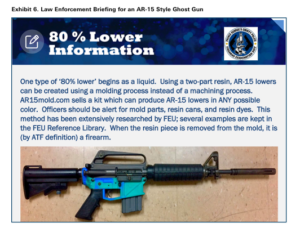
A small number of agencies have taken more extensive steps in developing greater awareness of ghost guns. This included briefings and trainings for forensic personnel, investigators, specialized units, and patrol officers. LEAs reported that they had trained officers to identify and record ghost guns. However, some participants indicated that, from a patrol perspective, the use or recovery of ghost guns (versus commercially manufactured firearms) did not have much of an impact. More comprehensive approaches have focused on producing guidance on what actions to take if a ghost gun was recovered, best practices for recording/reporting ghost guns, and legal status and appropriate charges for ghost gun possession or manufacture. For example, the NYPD developed a training program for its field intelligence teams. Their plan was for each team to distribute the training to their facilities’ patrol officers during rollcalls and for the academy to incorporate ghost gun training into standard curricula.
ATF AND EXTERNAL COLLABORATIONS
In the absence of a clearer and more consistent mandate to track, there is little reliable evidence about the quantity of ghost guns being produced or their role in crime. Information sharing between agencies (at the local level and between local and federal partners) is often accomplished through routine meetings and informal information sharing. There have been few efforts to systematize the transfer of information from local LEAs to federal partners. Despite these challenges, LEAs reported that the ATF played a critical role in facilitating information sharing about the prevalence of ghost guns, through both formal and informal communication among agency staff and ATF personnel.
Moreover, a majority of LEAs mentioned collaborating with the ATF in addressing their agencies’ ghost gun recoveries. Besides alerts through NIBIN and e-trace systems, several agencies regularly consult with their local ATF representatives and maintain open communication regarding ghost guns. Several LEAs also mentioned working with their Federal Bureau of Investigation (FBI) and Drug Enforcement Agency (DEA) partners. The Wilmington Police Department, for example, has formalized their ghost gun protocol to include the ATF; whenever a forensic analyst processes a ghost gun, they email their assigned Task Force Officer (TFO) with case details. The TFO then begins their investigation.
A few LEAs noted local information sharing efforts around ghost guns. Miami Police Department, for example, regularly engages with Miami Gardens, Miami Dade County, and Fort Lauderdale police to discuss firearm related trends. However, some LEAs expressed a desire for more national and/or regional efforts to inform officers about ghost guns, one officer from the San Diego Police Department stated: “Getting a national effort together to deal with the [ghost gun] issue has been difficult since it is primarily located in California, New York, and Chicago.” In that vein, some LEAs also expressed a wish to know more about how other agencies, particularly those with higher volume of ghost gun recoveries, were handling the issue. All LEAs reported that it would be wise to start preparing for a likely uptick in ghost gun involvement in crime, as an officer from the Miami Police Department said, “We’ve only encountered four, but [it] would be good to get ahead of the curve.”
DISCUSSION
In cities across the country, LEAs are growing increasingly concerned about the threat that ghost guns pose to the safety of their communities. This project explored the experience of two dozen LEAs with ghost guns; dozens of interviews with law enforcement stakeholders explored issues of ghost gun prevalence, training implementation and needs, and procedures and policies for tracking, tracing, and handling them. Twenty-two out of the 24 LEAs included in this study had encountered at least one ghost gun in recent years. Representatives from all agencies (even those without ghost gun recoveries) expressed growing concern over the increasing use of ghost gun in firearm violence.
Ghost guns primarily take two forms: (1) 3D-printed firearms, and (2) commercially produced components and kits that require some machining to become a functional firearm. Although these different approaches both result in ghost guns, the manufacture and production of ghost guns through 80% kits and components is considerably wider than 3D printing. Full 3D printing of firearms still has technical challenges that have not been fully addressed with consumer-grade 3D printers. Advances in design and at-home printing technology may eventually make 3D-printed firearms a greater public safety concern, but at this time, results suggest that the overwhelming majority of ghost gun recoveries have been from commercially produced components and kits. Despite media attention around 3D-printed firearms, the unregulated market of commercially produced ghost gun kits and components is a far more salient concern for public safety.
Consistent with previous reports (Stephens, 2019a), the prevalence of ghost gun recoveries by LEAs shows a great deal of variance. Higher levels of recovery have been consistently found in California and larger East Coast cities. The most likely explanation for this is that the legal purchase of traditional firearms in these areas is more difficult than in other parts of the country. This suggests that the purchase of ghost guns may represent an attempt to circumvent more restrictive purchase and possession requirements, especially by people who are ineligible or restricted from purchasing firearms. As awareness of ghost guns grows and the advantages to those with criminal intent become more well-known, we should expect to see ghost guns becoming a larger and larger share of the illegal guns being recovered in America.
Reliable information about the use of ghost guns in crime and firearm-related injuries is inconsistently collected and reported. Whilst several agencies described collaboration with local agencies and the ATF, most agencies had not taken formal steps to track the data. Inconsistencies around the procedures to collect and report these data make it difficult to estimate the national prevalence of crime-involved ghost guns. It is likely that the true scope of the ghost gun problem is larger than currently estimated. Until more reliable methods of training, identification, and recording are developed and implemented, knowledge about the impact of ghost guns on public safety will remain incomplete.
LIMITATIONS AND AVENUES FOR FUTURE RESEARCH
Participating agencies were not selected at random, and therefore, agency-level data on the number of ghost gun recoveries should not be used to produce national estimates. We note that agencies that participated in this study tended to be municipal agencies and larger; sheriffs and smaller jurisdictions were under-represented. Smaller LEAs, in particular, are likely to face even greater challenges in training officers in proper recovery and identification procedures. More research is needed to understand how to support these agencies.
IMPLICATIONS FOR RESEARCH
There is little information about characteristics of ghost guns or the purchasers of ghost guns. While it is clear that the market for ghost gun component parts and kits has grown exponentially over recent years, specific information on the production and distribution of these components and kits is extremely limited. It is unknown how many component parts or kits are being produced, how many people are buying kits and components, how many kits of components are purchased by individuals, or how and where they are being distributed. However, as mentioned previously, ghost gun sellers are spread throughout the country and online sellers are able to ship into any state where the product is legal. Most critically, there is no reliable information about who purchases ghost gun kits and components. Although limited, some research exists on purchasers of traditionally manufactured firearms; no parallel information exists for purchasers of ghost guns. We do not know why people acquire ghost guns over traditionally manufactured firearms. For example, we do not know if the acquisition of ghost guns is due to limited availability of traditionally manufactured firearms (e.g., because of high demand leading to limited stock) or if it is because the purchaser is unwilling, or ineligible, to go through the traditional firearm acquisition process. Clarifying the motivation of ghost gun purchasers may be useful for enhancing a coordinated public safety strategy. While some information about the sales and marketing of ghost gun components and kits can be gleaned from a cursory review of the online market, a more principled and systematic market analysis is warranted.
Questions that could be addressed include:
• What are the predominant distribution chains for ghost gun components and kits?
• Are more components and kits sold through physical retail stores or online?
• Are sales primarily through conventional online firearm retailers or dedicated ghost gun component and kit retailers?
• Do aspects of ghost gun components and kit marketing (such as highlighting the fact that background checks are not required or the lack of a serial numbers) make them more attractive to individuals who could not otherwise legally purchase a firearm?
Addressing these key questions would facilitate a better understanding of the commercial marketing for ghost gun components and kits.
From a technical perspective, more research is needed to understand the unique challenges of tracing ghost guns. This will be especially important for 3D-printed firearms. It is possible that the unique characteristics of printers, print material, and CAD manufacturing files may create unique signatures that identify who, and where, devices were created. Part of the challenge in tracking and understanding the impact of ghost guns is the inconsistencies in identification and tracking. No research exists on the accuracy or consistency of ghost gun identification by officers and forensic staff. Training and bulletins on identification strategies have not been tested for effectiveness. Further research on the best way of training officers and forensic experts on identifying ghost guns could improve the reliability of ghost gun recovery data.
IMPLICATIONS FOR PRACTICE
The growing prevalence of ghost guns recovered by law enforcement signals the need to strengthen how ghost gun kits and components are regulated and sold. As documented by others (e.g., Everytown Research and Policy, 2020) the differences between ghost guns and fully functional firearms are very small. Improvements in manufacturing have made ghost guns easier than ever to convert from kit to functional firearm. With many kits, this can be accomplished with only minimal hand tools and no specialized machining skills. In May 2021, the Justice Department proposed new rules that would require retailers of the partially finished frame or receiver (whether sold independently or as part of a kit) to conduct background checks on purchasers, require a serial number on frames or receivers currently used to build ghost guns, and require that federally licensed firearms dealers add a serial number to any 3D-printed or other unserialized firearms that they take into inventory. At the time of publication, these rules were undergoing public comment.
Participants frequently noted the need for national identification and reporting standards. Several officials from agencies indicated that they believed it likely that not all ghost guns had been correctly identified. There is a need to develop agency- and officer-level guidance on identification and handling procedures for ghost guns. Going forward, participants indicated that they would benefit from national standards for identifying, tracking, processing, and reporting ghost guns. LEAs acknowledged that preparing for increased rates of ghost gun recoveries would be wise. Standardizing ghost gun best practices before recoveries become more widespread would be particularly useful.
Participants reported an interest in learning about how other agencies were handling ghost guns; some requested that the research team connect participants to other agency participants that had developed more comprehensive plans. An open communication platform for staying up to date on useful strategies other LEAs implement would also be beneficial. Several participants indicated that periodic reminders via intel bulletins and in-service training would be useful to ensure officers recognize and track ghost guns correctly. A convening of agencies and officers to share this and other information and to provide training may be particularly valuable.
Interviews with LEA forensic staff identified the need to develop better training and procedures for safely handling ghost guns. Several participants suggested that the handling procedures for ghost guns was inconsistent within and between agencies. Forensic staff need clear guidance on identifying and recording ghost gun. This should be conducted periodically with updates based on emerging trends.
RECOMMENDATIONS
Based on more than 30 interviews with representatives from dozens of agencies, several policy recommendations emerged. The recommendations address stopping the proliferation of ghost guns through regulating the people and companies engaged in the business of making and selling ghost gun component parts through updating the outdated definition of firearm, and improving the processes for state and local governments that come across ghost guns that are in the public domain.
1. THE SALE OF GHOST GUN KITS AND COMPONENTS SHOULD BE REGULATED TO ENHANCE PUBLIC SAFETY.
LEAs indicated there was growing concern over the role of ghost guns in contributing to firearm violence. Given the relatively low barrier to completing a functional firearm, the purchase of ghost gun kits and core components should be subject to the same rules, regulations and checks as traditionally manufactured firearms. Proposed regulations by the ATF (currently undergoing public comment) would address this issue by implementing regulations covering components that can readily be converted into firearm frames and receivers needed to assemble a functional firearm.
2. SERIAL NUMBERS AND IDENTIFIERS ON GHOST GUN KITS ANDCOMPONENTS SHOULD BE REQUIRED BY LAW.
LEAs consistently reported the challenge created by the lack of serial numbers of ghost guns. Proposed regulations by the ATF would require that kit and component manufacturers assign and imprint serial numbers on parts that can readily be converted to a functional firearm.
3. A NATIONWIDE STANDARD FOR REPORTING THE PRODUCTION, SALE, AND RECOVERY OF GHOST GUNS AT LOCAL, STATE, AND FEDERAL LEVELS SHOULD BE CREATED.
A key gap in understanding the impact of ghost guns is the lack of available data on their production, sale, and recovery by LEAs. The inconsistency, and lack of nationally representative data, makes it impossible to produce national estimates about the role of ghost guns in violent crime.
• Consistent with the procedures for recording of conventionally manufactured firearms, ghost gun kit, and component manufacturers should be required to record sales.
• Wherever possible, granular information should be provided by agencies that will allow generation of national- and sub-national estimates of ghost guns known to LEAs. Information shared should include (1) reason for recovery, (2) location of recovery (3) type of firearm, (4) kit or component manufacturer, (5) caliber, and (6) other characteristics that may be informative for research or regulatory purposes.
• Deidentified data on ghost gun recoveries should be shared publicly by LEAs. Existing open data portals can be leveraged to share critical information useful for public policy and research.
4. ENHANCED TRAINING FOR LOCAL, STATE, AND FEDERAL OFFICERS AND FORENSIC PERSONNEL IDENTIFYING AND RECORDING INFORMATION ON GHOST GUN RECOVERIES SHOULD BE PROVIDED.
Currently, training and strategies for identifying ghost guns varies between agencies. Training materials are developed by each agency and there is no consistency on methods of delivering the training. In-service training should be available to help officers identify and properly respond to ghost guns encountered in the field. Forensic staff should be given training on ghost gun identification, tracking, and handling safety. Comprehensive information about ghost gun types and brands, known vendors that sell parts that can be used for ghost guns, and procedures for identifying and handling ghost guns, should be provided more consistently to state and local law enforcement agencies and officers. This information can be disseminated through existing channels such as Fusion Centers and Regional Information Sharing Systems (RISS).
5. PROCESSES AND STRATEGIES TO FACILITATE WITH-IN AND BETWEEN-AGENCY INFORMATION SHARING SHOULD BE ENCOURAGED AT LOCAL, STATE, AND OTHER LEVELS.
There was considerable demand for examples, demonstrations, and technical architecture for improved communication around ghost guns, and firearm violence more generally, within- and between-agencies (e.g., between agencies’ forensics and GCIC labs). This desire could be
supported through a number of strategies, including the development and publication of reporting best practices and organizing methods of regional information sharing.
6. TRAINING AND TECHNICAL ASSISTANCE AND TECHNOLOGY ENHANCEMENTS TO FACILITATE THE IDENTIFICATION AND TRACKING OF GHOST GUNS SHOULD BE PROVIDED TO STATE AND LOCAL LEAS.
Local LEAs have limited resources for officer training. Resources should be developed to provide in-person and online training for identifying and tracking ghost guns. Front-line officers, who are most likely to recover firearms, would particularly benefit from training on how to identify ghost guns, including how to recognize the gun parts and machinery that enable the assembling of a functioning ghost gun, brands and vendors to look out for, where a serial number should be located, and how to differentiate between an unserialized and an obliterated firearm. Trainings should include step-by-step guidance on how to handle a ghost gun post-recovery, including safety precautions (e.g., if a ghost gun is not assembled properly). Information on each agency’s procedures for tagging, tracking, and communicating with the relevant staff (e.g., specialized units, task force members, command staff, forensics), should also be covered in the training. Moreover, a comprehensive training would include information on federal and state legislations, circumstances appropriate for seizing a ghost gun, and the appropriate charges if an arrest is warranted.
7. RESEARCH TO ASSESS THE ACCURACY AND RELIABILITY OF OFFICER FIELD IDENTIFICATIONS SHOULD BE SUPPORTED TO UNDERSTAND THE PREVALENCE OF UNDER-REPORTING GHOST GUN INVOLVEMENT IN CRIMES.
Several participants indicated that they believed recording of ghost guns was being undercounted because of failure to identify and distinguish them from traditionally manufactured firearms. Systematic evidence exploring the accuracy of ghost gun identification could be used to estimate the prevalence of ghost gun underreporting among LEA official statistics.
8. RESEARCH TO INFORM UNDERSTANDING OF THE MOTIVATIONS TO PURCHASE GHOST GUN SHOULD BE SUPPORTED TO BETTER INFORM ADDITIONAL POLICYMAKING.
Our understanding of why people are purchasing ghost guns is relatively limited, though it is plausible that the absence of background checks, the ease of access and rapid availability, inability to trace the weapon, and cost factors are among the considerations. A more complete understanding of the motivations for purchasing ghost gun kits and components would facilitate better strategies to address the unique public safety concerns created by ghost guns and future technological advancements.
References
Andone, D. (2019, November 21). The gunman in the Saugus High School shooting used a ‘ghost gun,’ sheriff says. CNN. https://www.cnn.com/2019/11/21/us/saugus-shooting-ghost-gun/index.html
Allen, J. (2019, February 23). Untraceable, unregulated and easy to build: Colorado and the increasing popularity of ‘ghost guns’. Denver7 360. https://www.thedenverchannel.com/news/360/untraceable-unregulated-and-easy-to-build-colorado-and-the-increasing-popularity-of-ghost-guns
Allyn, R. (2021, April 23). Untraceable “ghost gun” allegedly used in fatal Gaslamp shooting spree. CBS8. https://www.cbs8.com/article/news/local/untraceable-ghost-gun-allegedly-used-in-fatal-gaslamp-shooting-spree/509-cc352272-85d9-4e4b-bc1b-7446dcb96660
Associated Press. (2020, August 26). San Jose, Chicago and 2 other cities sue to stop spread of ghost guns. Los Angeles Times. https://www.latimes.com/world-nation/story/2020-08-26/chicago-and-3-other-cities-sue-to-stop-spread-of-ghost-guns
ATF. (2020, April 6). Are “80%” or “unfinished” receivers illegal?. ATF. https://www.atf.gov/firearms/qa/are-“80”-or-“unfinished”-receivers-illegal
Baker, C. (2020, August 26). Walsh sues Trump Administration after huge rise in homemade ‘ghost guns’. Syracuse.com. https://www.syracuse.com/news/2020/08/walsh-to-sue-trump-administration-after-huge-rise-in-homemade-ghostguns.html#:~:text=During%20a%20conference%20call%20Wednesday,ghost%20guns%20countywide%20in%202019
Beer, T. (2020, June 16). Accused Killer of California cops was Associated with right-wing ‘Boogaloo Movement’. Forbes. https://www.forbes.com/sites/tommybeer/2020/06/16/accused-killer-of-california-cops-was-associated-with-right-wing-boogaloo-movement/?sh=55e9412059bd
Beyer, K. E. (2014). Busting the Ghost Guns: A Technical, Statutory, and Practical Approach to the 3-D Printed Weapon Problem. Kentucky Law Journal, 103(3), 433-456.
Blankstein, A, & Siemaszko, C. (2017, November 16). California mass shooter made his own rifles. NBC News. https://www.nbcnews.com/news/us-news/california-mass-shooter-made-his-own-killing-machines-n821516
Doherty, B. (2021, April 28). California already tried Biden’s ghost gun ban. It didn’t work. Reason. https://reason.com/2021/04/28/california-already-tried-bidens-ghost-gun-ban-it-didnt-work/
Engel, P. (2013, June 14). Here’s the legal loophole that allowed the Santa Monica shooter to own a gun. Business Insider. https://www.businessinsider.com/legal-loophole-allowed-john-zawahri-to-obtain-a-gun-2013-6
Everytown Law. (2020, August 26). Cities, with support from Everytown, sue to compel Trump Administration to address growing threat from ‘ghost guns’. Everytown for Gun Safety. https://everytownlaw.org/press/cities-with-support-from-everytown-sue-to-compel-trump-administration-to-address-growing-threat-from-ghost-guns/
Everytown Research and Policy. (2020, May 14). Untraceable: The rising specter of ghost guns. Everytown for Gun Safety. https://everytownresearch.org/report/the-rising-specter-of-ghost-guns/
Everytown for Gun Safety. (2021, May 7). ATF’s proposed rule would stem the rise of unregulated ghost guns. Everytown for Gun Safety. https://www.everytown.org/report/atfs-proposed-rule-would-stem-the-rise-of-unregulated-ghost-guns/
Fletcher, L. (2020, July 23). As demand for DIY, serial number-less ‘ghost guns’ rises, so does demand for tougher laws. WJLA. https://wjla.com/features/7-on-your-side/washington-dc-ghost-guns-tougher-laws
Gaskill, H. (2021, June 23). Baltimore Police on track to double ghost guns recovered in 2020, says Deputy Commissioner. Maryland Matters. https://www.marylandmatters.org/2021/06/23/baltimore-police-on-track-to-double-ghost-guns-recovered-in-2020-says-deputy-commissioner/
Ghost Guns. Giffords Law Center (n.d.). https://giffords.org/lawcenter/gun-laws/policy-areas/hardware-ammunition/ghost-guns/#footnote_29_5657
Gomez, A. M. (2020, January 10). D.C. recovered 115 ghost guns in 2019, Up from 25 the year before. Washington City Paper. https://washingtoncitypaper.com/article/323393/dc-recovered-115-ghost-guns-in-2019-up-from-25-the-year-before/
Grimshaw, S. (2021, April 7). Montgomery County a step closer to banning ‘ghost guns’. WDMV. https://www.localdvm.com/news/maryland/montgomery-county-a-step-closer-to-banning-ghost-guns/
Hermann, P. (2020, March 11). D.C. mayor signs law banning ‘ghost gun’ kits from District. The Washington Post. https://www.washingtonpost.com/local/public-safety/dc-mayor-signs-law-banning-ghost-gun-kits-from-district/2020/03/11/07c36f56-6393-11ea-b3fc-7841686c5c57_story.html
Hitt, B. (2020, January 31). ‘Ghost guns’ investigation: Law enforcement seeing unserialized firearms on daily basis in SoCal. ABC7 Eyewitness News. https://abc7.com/law-enforcement-seeing-ghost-guns-on-daily-basis-in-socal/5893043/
Jacobs, J. B., & Haberman, A. (2017). 3D-printed firearms, do-it-yourself guns, & the Second Amendment. Law & Contemporary Problems, 80, 129.
Stephens, A. (2019, May 17). Ghost guns are everywhere in California. The Trace. https://www.thetrace.org/2019/05/ghost-gun-california-crime/
Stephens, A. (2019, November 20). Officials confirm Santa Clarita Shooter used a ghost gun. The Trace. https://www.thetrace.org/2019/11/santa-clarita-school-shooting-ghost-gun/
Wintemute, G. J. (2021). Ghost guns: Spookier than you think they are. Injury Epidemiology, 8(1), 1-3. https://doi.org/10.1186/s40621-021-00306-0
Zapotosky, M. (2021, May 7). Justice Dept. details proposed restrictions on ‘ghost guns’. The Washington Post. https://www.washingtonpost.com/national-security/biden-ghost-guns/2021/05/07/0d20ef86-af74-11eb-acd3-24b44a57093a_story.html
Zezima, K. (2018, August 1). Despite ruling on 3-D-printed guns, it remains legal to make your own gun at home. The Washington Post. https://www.washingtonpost.com/national/despite-ruling-on-3-d-printed-guns-it-remains-legal-to-make-your-own-gun-at-home/2018/08/01/581ca5a6-95c9-11e8-a679-b09212fb69c2_story.html
Conflict of Interest Disclosure
The authors of this study certify that they have NO affiliations with or involvement in any organization or entity with any financial interest (such as honoraria; educational grants; participation in speakers’ bureaus; membership, employment, consultancies, stock ownership, or other equity interest; and expert testimony or patent-licensing arrangements), or non-financial interest (such as personal or professional relationships, affiliations, knowledge or beliefs) in the subject matter or materials discussed in this publication.
Written by
Travis Taniguchi, PhD
Katherine Hoogesteyn, PhD
Eiryn Renouard
Dean Esserman, JD
Topic Area(s)
For general inquiries, please contact us at info@policefoundation.org.
Share
Strategic Priority Area(s)
Topic Area(s)
For general inquiries, please contact us at info@policefoundation.org
If you are interested in submitting an essay for inclusion in our OnPolicing blog, please contact Erica Richardson.
Share