
May 13, 2026

Gabrielle T. Isaza, Ph.D.
Senior Research Associate
Gabrielle T. Isaza, Ph.D.
Senior Research Associate
Over the past decade, high-profile use of force incidents in the U.S., particularly those involving unarmed individuals or those armed with non-firearm weapons, have intensified public scrutiny of law enforcement officers and reshaped expectations for how officers engage with the communities they serve. Today, officers are expected to have the tactical skills, communication skills, and sound judgment to de-escalate tense situations and advance conflict resolution before resorting to coercive force. In response, policymakers, practitioners, and the public increasingly recognize that agencies must prioritize training that reduces tension, stabilizes critical situations, and minimizes the immediacy of potential threats. This shift is reflected in federal legislation, including the Law Enforcement De-escalation Training Act of 2022 (LEDTA), and in the growing demand from communities for agencies to treat de-escalation as a core professional competency rather than an optional skill set.
These skills are often imparted and practiced during de-escalation and crisis response training and reinforced through departmental policy and supervision. Effective agency programs that promote de-escalation must be holistic, combining training, policy, and supervision. Together, these efforts reinforce field decision-making across three core areas:
- Identifying a crisis
- Effective rapport building, verbal de-escalation, and nonverbal communication
- Use of distance and cover to create time and expand available options for safely resolving encounters
This post will discuss how to bridge the gap between theoretical knowledge of what works in de-escalation and its practical application in real-world de-escalation programming. Adopting evidence-informed training and strategies can optimize departmental resources, minimize use of force liabilities, and enhance public safety for officers and the communities they serve.
Talk to One of NPI’s Law Enforcement Experts
What Works: Evidence-Informed De-escalation Strategies
At its core, de-escalation is a process meant to reduce the severity of conflict during police-civilian interactions, allowing time for communication and response options that might reduce the need for coercive force. That is not to say that every situation is amenable to de-escalation, but many do benefit from this strategy. The process involves recognizing that a crisis is occurring or about to occur, applying de-escalation techniques that draw on verbal and non-verbal skills, including active listening, body language, eye contact, and attention to nonverbal cues, to gather information, build rapport and communicate, awareness of personal space and repositioning to leverage distance and cover, and planning approaches and scene coordination when possible.
Key to de-escalation is recognizing a crisis—a situation that overwhelms a person or exceeds their ability to cope. Several factors may contribute to a crisis, including situational stress, trauma, mental health conditions, substance use or substance abuse disorders, cognitive disabilities (e.g., intellectual and developmental disabilities, brain injury), and other forms of neurodivergence. In some cases, an appropriate response also includes coordinating with healthcare professionals to connect individuals to the services they need. The signs, symptoms, and appropriate law enforcement responses may vary depending on the factors contributing to the crisis, making recognition a vital step in the de-escalation and crisis intervention process. Teaching and practicing decision-making skills for these high-stress crisis encounters is another important facet of effective de-escalation.
De-escalation strategies are taught and reinforced during training. There are dozens of off-the-shelf de-escalation training programs available to law enforcement, along with even more agency-developed programs. Only a handful have been subject to scientific evaluation, with some studies using more rigorous methods than others. The Police Executive Research Forum’s Integrating Communications, Assessment, and Tactics (ICAT), a 12-hour de-escalation training course, is the only program to have demonstrated statistically meaningful reductions in use of force incidents across two separate, independent evaluations.
The Bureau of Justice Assistance’s Crisis Response and Intervention Training (CRIT), developed by a research team from the University of Cincinnati, offers an innovative 40-hour crisis response curriculum. CRIT was heavily informed by research and best practices in crisis response and de-escalation. While it has not yet been scientifically evaluated, it is a promising model supported by the Department of Justice, with current federal funding opportunities available to law enforcement agencies.
Currently, the National Policing Institute (NPI) is partnering with the Police Executive Research Forum (PERF) to develop a national model for de-escalation training, a hybrid program based on ICAT and CRIT, titled Advanced Crisis Communication and Tactics (ACCT). Over the summer and fall, NPI and PERF will pilot test the 24-hour training program with the Las Vegas (NV) Department of Public Safety, the Marquette University (WI) Police Department, and the Daphne (AL) Police Department, and hope to train with others in the future.
When departments adopt established de-escalation training programs such as ICAT, CRIT, or ACCT, model fidelity is a key factor in whether those programs deliver their intended results. Training staff should complete the program’s train-the-trainer process and apply the guidance in the implementation materials to ensure sessions are delivered consistently and aligned with core learning objectives. Local customization can be a valuable adaptation tool, but modifications to core components or competencies should be avoided, as these elements underpin the program’s design and effectiveness
Understanding what the evidence supports is a necessary first step, but knowing where programs commonly fall short is equally important.
What Doesn’t Work: Common Pitfalls and Ineffective Approaches
Knowing what to avoid is just as important as knowing what to adopt. It’s unclear which specific components of de-escalation training do not work, given the lack of research. Evaluations of other de-escalation training programs that did not find reductions in use of force do not necessarily mean the training “didn’t work.” This is because measuring changes in officer behavior, especially related to the use of force, is incredibly complex. Nevertheless, several pitfalls and ineffective approaches are identified here to avoid in de-escalation training.
First and foremost, any training that does not integrate realistic skill practice for participants should be avoided. Integrating direct, practical application of skills taught during training is paramount to the successful transfer of knowledge and skills. Skill practice should also be coupled with instructor feedback and should allow a training participant to explain their decision-making following practice.
Given the importance of realistic skill practice in de-escalation training, the efficacy of online courses is questionable. While digital modules can convey important learning concepts related to communication and crisis recognition, it is also important to use in-person, hands-on, scenario-based training to refine skills for high-stress encounters. Further, online settings offer limited opportunities for group discussions, activities, and role-plays, which require direct interaction.
Research has not yet determined the optimal length or dosage of de-escalation training. However, it is recognized that allowing sufficient time for learning concepts, discussion, and skill practice in de-escalation training is challenging to accomplish in a short session, such as one lasting less than 8 hours. Evidence also underscores the importance of repetition—de-escalation training cannot be a “one-and-done” program.
Finally, agencies should consider the qualifications of de-escalation training instructors. Instructors who are not well-versed in the topic or who have little practical experience in law enforcement are unlikely to be effective. Instructors should have credibility with line officers and other training participants to promote receptivity to the training content.
How Agencies Can Evaluate De-escalation Training
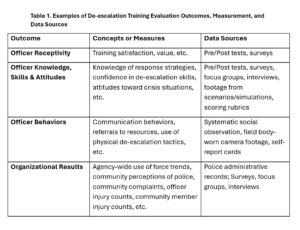
Measuring training impact does not have to be an overwhelming undertaking; the key is identifying the right outcomes from the start. Given the limited body of research directly evaluating de-escalation training, it is critical for agencies and their partners to systematically measure its impacts on both officers and the communities they serve. A practical starting point is for agencies to identify which outcomes matter most for gauging program success. Several relevant outcomes are presented in Table 1.
Measuring the effects of de-escalation training can be challenging, particularly when assessing meaningful changes over time in agency-level outcomes such as use of force incidents and force-related injuries. The National Policing Institute can assist departments in identifying appropriate outcomes, data collection strategies, and analysis methods tailored to their context and priorities.
Table 1. Examples of De-escalation Training Evaluation Outcomes, Measurement, and Data Sources
Elevate Your Agency’s Training Standards
Identifying and implementing evidence-informed de-escalation training, policy, and supervision practices are paramount to meeting the demands of modern-day policing. Agencies also have a meaningful role to play as partners in building the evidence base for what works and what does not in de-escalation training. Until now, there has been no national guidance to help agencies select effective, evidence-informed training, and programs vary widely across the country, leaving departments without a reliable way to know what works. Significant funding and resources driven by LEDTA are on the horizon to address that gap directly.
The National Policing Institute will soon release Guidance for Safer Policing: A Blueprint for Law Enforcement De-escalation Training, developed in collaboration with PERF, the Bureau of Justice Assistance (BJA), and Department of Justice (DOJ) partners. Through this collaboration, the National Policing Institute, PERF, and other subject matter experts will also be available to provide training resources and technical assistance to agencies seeking to strengthen their de-escalation and crisis response training, policies, and practices, at no cost, by submitting a request through BJA’s National Training and Technical Assistance Center (NTTAC) or reaching out to NPI directly.
This summer will also bring the launch of a standards-based assessment process developed in partnership with the DOJ’s Office of Community Oriented Policing Services (COPS Office). Through this collaboration, the National Policing Institute and the Institute for Intergovernmental Research have launched LEDTAtraining.org, a central resource hub for law enforcement agencies working to advance their de-escalation efforts. The site will feature a catalog of de-escalation and crisis response training programs that have been vetted and certified through the assessment process in accordance with the COPS Office National Standards for De-escalation Training.
Across all of these initiatives, the shared goal is clear: making policing safer for officers and the communities they serve. The National Policing Institute is committed to supporting your agency’s efforts; please reach out to learn how we can help.
Written by
Gabrielle T. Isaza, Ph.D.
Senior Research Associate
Audience
Topic Area(s)
For general inquiries, please contact us at info@policefoundation.org.
Share
Strategic Priority Area(s)
Topic Area(s)
For general inquiries, please contact us at info@policefoundation.org
If you are interested in submitting an essay for inclusion in our OnPolicing blog, please contact Erica Richardson.
Share