
November 19, 2025

When someone in crisis calls for help, law enforcement is often the first to arrive. These situations require compassionate and coordinated intervention to ensure the safety of officers and community members, while supporting individuals’ connections to services.
Across the country, agencies are enhancing their response capabilities by implementing specialized training (e.g., Crisis Response and Intervention Training) and crisis response programs, such as Crisis Intervention Teams (CIT), co-responder programs, and other crisis response initiatives, to address this need. While providing specialized training and implementing programs are vital, it is imperative that agencies examine the impact of these efforts and ask the critical question: Are these efforts working? That’s where evaluation comes in.
Why Evaluation Matters
 Evaluation isn’t just about data; it’s about strategy. It helps agencies move beyond assumptions to understand what’s effective, what needs refinement, and where resources can have the strongest impact. A strong evaluation can:
- Reveal what works and what doesn’t
- Identify ways to enhance training and outcomes
- Build community trust through accountability and transparency
- Support long-term program sustainability
Without evaluation, agencies risk investing in initiatives that may not meet their goals or community needs. Evaluation turns lessons into progress and good intentions into measurable results.
A Guide Built for Law Enforcement Leaders
Seeking to support agencies’ evaluation activities, the National Policing Institute (NPI), in collaboration with the International Association of Chiefs of Police (IACP) and other partners, led the development of the Evaluation Guide: Considerations for Crisis Response and Intervention Training (CRIT) and Crisis Response Program Evaluations.
This guide is a practical, step-by-step resource for law enforcement agencies and their partners to plan and conduct an evaluation of crisis response training and programs. Whether you’re a police chief, a program coordinator, or a community stakeholder, understanding the value of evaluation—and how to do it well—can transform your agency’s approach to crisis response.
The Many Faces of Evaluation
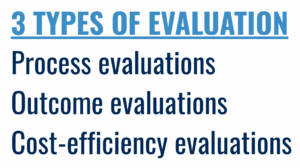 There are several types of evaluations that can answer different questions.
1. Process evaluation: How is the program working?
This looks at how a program is implemented and can provide context for how and why the program results (or does not result) in certain outcomes. It can help leaders understand:
-
- Is the curriculum and training being delivered as intended?
- Are behavioral health partnerships functioning smoothly?
- What barriers are officers or staff encountering?
By focusing on implementation, process evaluations help agencies maintain fidelity to their program design and identify operational challenges early.
2. Outcome evaluations: What difference does it make?
This type of evaluation measures impact. They answer questions such as:
-
- Are officers using de-escalation skills more effectively?
- Are fewer people being arrested or hospitalized unnecessarily?
- Are community interactions with trained officers improving?
These evaluations move the focus from activity (“we trained 50 officers”) to results (“our responses are safer and more effective”).
3. Cost-efficiency evaluation: Is it worth the investment?
This answers questions about whether a program is economically achieving its intended goals. For example:
-
- Is a co-responder program cost-effective compared to a traditional response?
- Can the same outcomes be achieved with fewer resources?
Combining multiple types of evaluations can provide a holistic picture of how a program operates and its impact on various stakeholders. For instance, an outcome evaluation can be strengthened by also completing a process evaluation. A process evaluation helps ensure fidelity and consistency, while an outcome evaluation reveals impact and effectiveness.
Building a Strong Evaluation
There are several key considerations when designing a program evaluation.
1. Set clear goals and objectives.
Goals should be specific, measurable, and aligned with community needs. What is your crisis response program trying to achieve? Your evaluation questions should be related to your program’s goals, the purpose of the evaluation, and the intended audiences. The Evaluation Guide includes a sample logic model for a crisis response training program that can inform evaluation planning.
2. Engage early with program stakeholders.
Evaluation should not happen in a vacuum. Involve relevant stakeholders (e.g., officers, behavioral health partners, funding agencies, community members) when designing an evaluation.
3. Use a mixed-methods approach.
Ideally, a program evaluation should involve multiple methods (e.g., qualitative methods – focus groups with officers, interviews with program personnel, and quantitative methods – analyses of agency records). Using multiple data sources can offer a comprehensive summary of how your program is working.
4. Use evaluation findings to inform training and program practices.
Evaluation findings should inform updates to training, policies, practices, and partnerships. Building in opportunities for continuous improvement will help the program evolve and stay effective.
Partnering for Success
The NPI team includes experts in crisis response and training who specialize in developing, implementing, and evaluating effective programs. NPI professionals are experienced in collaborating and partnering with law enforcement agencies nationwide to deliver comprehensive training, hands-on technical assistance, and robust evaluation support, ensuring strategies that truly make an impact.
NPI researchers can provide valuable insights into designing and implementing an evaluation. Our experts can help your agency:
- Develop a data collection plan
- Tailor an evaluation design to match the agency’s questions and resources
- Conduct data analysis and interpret the results
- Communicate findings clearly to internal and external audiences
Let’s work together to enhance your agency’s crisis response training and programs.
Final Thoughts
 Crisis response training and programs are a vital step toward safer, more compassionate policing. Integrating evaluation into our training and program implementation can ensure our good intentions translate into real impact. The Evaluation Guide offers a roadmap for agencies ready to integrate evaluation into their crisis response initiatives. By embracing evaluation, law enforcement agencies can improve outcomes, strengthen relationships, and lead the way in innovative, evidence-informed crisis response.
Written by
Audience
Topic Area(s)
For general inquiries, please contact us at info@policefoundation.org.
Share
Strategic Priority Area(s)
Topic Area(s)
For general inquiries, please contact us at info@policefoundation.org
If you are interested in submitting an essay for inclusion in our OnPolicing blog, please contact Erica Richardson.
Share