
April 22, 2026

Christine Johnson, M.S.
Program Manager

Brett Cowell, M.A.
Senior Program Manager
Christine Johnson, M.S.
Program Manager
Brett Cowell, M.A.
Senior Program Manager
Now more than ever, officer safety and wellness are critical issues in law enforcement. Annually, law enforcement officers are lost due to felonious assaults, officer-involved collisions, and struck-by incidents at alarming rates. Law enforcement will never be risk-free, but can you reduce the risks through better decision-making about risk-taking?
Organizational Culture and Influence
Organizational culture plays a key role in impacting officer safety. What is culture? Culture is an organization’s shared values, attitudes, beliefs, and practices. An organization with a strong safety culture demonstrates this through safe practices on the job. Unfortunately, a culture that runs counter to its values can undermine the best policies. As the saying goes, “Culture eats policy for lunch.” If your officers or supervisors allow violations of safety policies, your personnel will recognize the lack of accountability, and your safety culture will quickly crumble.
Make safety one of your agency’s top values. It should influence every aspect of your operations, from budgets and policies to promotional processes. Are you selecting and promoting officers who will enhance your safety culture? Do you test for knowledge of safety practices in promotions? Are your trainers, FTOs, and supervisors modeling safety? Is your command staff?
Roadway Safety, Officer Decision-Making, and Agency Accountability
What do we know about officer decision-making regarding speed? We know officers tend to drive fast, often exceeding speed limits, responding to calls. Sometimes this is necessary, but most of the time, the benefit of arriving one minute earlier doesn’t justify the added risk. Speed is a significant factor in crash survivability; it’s the strongest risk factor in motor vehicle crash fatalities.
Law enforcement has a culture of speed that extends beyond driving. From the early days of the academy, officers are taught to do everything quickly. In driver training, officers are typically required to complete courses within set time limits. On patrol, the public and department leadership expect officers to clear calls quickly to keep them from stacking up. If officers are constantly evaluated by the speed at which they do things, is it any wonder cops drive fast?
How can we dismantle the ways in which agencies inadvertently reinforce the harmful culture of speed? The Federal Law Enforcement Training Center (FLETC) serves as a prime example by removing the time standard from the practical test in its basic driver curriculum. This shifts the focus from completing the course as quickly as possible to doing it as safely as possible. It may sound like they’re going soft on the recruits, but FLETC students are still pushing the vehicles according to vehicle telematics. Driving performance hasn’t degraded.
What do we know about officer decision-making around seat belt use? Research shows a strong association between injury severity and seat belt use. Seat belts are a significant factor in surviving a crash, yet many officers still don’t wear them. From 2017 to 2021, 47% of officers killed in crashes weren’t wearing their seat belts. What are some reasons officers skip their seat belts? One of the most common reasons offered is having the ability to exit the vehicle quickly in the event of an ambush. Officers think that if they wear their seat belts, the seat belts will slow them down, and they’ll get shot.
However, research doesn’t support this fear; between 2010 and 2016, only 8% of line-of-duty deaths were ambush-related, and most weren’t in their vehicles. The statistical likelihood of an officer being seriously injured or killed in a collision due to not wearing a seat belt is significantly higher than the likelihood of an officer getting stuck in their vehicle, on account of their seat belt, during an ambush. Incorporating seat belts into training can further reduce the risk of the latter.
Managing Fatigue and Offering Practical Sleep Solutions
Let’s talk about the elephant in the room: fatigue. While it’s generally accepted to come to work fatigued, it puts you at serious risk for collisions.
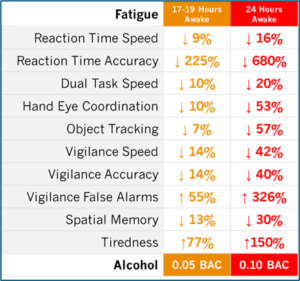
What do we know about fatigue and its impact on performance? At 17-19 hours awake, performance is impaired at a level similar to a blood alcohol content (BAC) of 0.05. After 24 hours awake, impairment equals a BAC of 0.10. If it’s not safe to drive while intoxicated, it’s not safe to drive while fatigued.
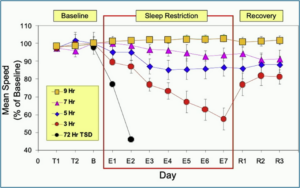
A study by the Walter Reed Army Institute of Research demonstrated that performance cannot be quickly recovered with a few days of extra sleep after a period of sleep deprivation. If you aren’t getting enough sleep during your shift rotation, you likely won’t be able to recover fully during the few days you have off. Agencies must identify and implement practical solutions to ensure officers have adequate opportunities for sleep and mitigate fatigue in their ranks. Having a fatigue management policy, which could include on-duty napping, is one way to accomplish this.
Holding Each Other Accountable
How can agencies help reinforce their safety culture? There must be accountability at all levels. Supervisors must hold subordinates accountable, and peers must hold each other accountable for safe practices. It’s not enough that a policy on seat belts or distracted driving exists; you must fully enforce it with consequences for noncompliance, regardless of a person’s rank. In law enforcement, consistency is key. Inconsistent application of discipline leads to low morale and confusion. Accountability tends to have a negative connotation, but this is an opportunity to recognize officers who operate safely. Reward positive behavior. Garner support from influential line officers and supervisors. Change starts at the top and needs to be supported by the rank and file to grow the new safety culture.
For peer-to-peer accountability to be effective, you need to have courageous conversations. Should you say something if you see your peer violating policy by not wearing their seat belt or even operating within policy but doing so recklessly? Ignored behavior is condoned behavior. What are the potential consequences if you don’t have that courageous conversation? Your peer could be seriously injured or killed or get someone else killed. Your peer could end up on the news, labeled as a “problem officer,” or receive disciplinary action from the agency, potentially ruining their career. If these things can be avoided, they should be.
Peer Accountability for Law Enforcement Safety
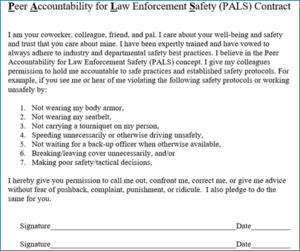
Peer-to-peer accountability and courageous conversations can be tough to do, which is why we created PALS, inspired by other law enforcement peer accountability models. PALS stands for Peer Accountability for Law Enforcement Safety. At the heart of the PALS concept is a formal agreement in which all participating officers pledge to hold one another accountable for safe behaviors, regardless of rank. This can make difficult conversations easier and less risky because you have given others permission to call out your unsafe behavior. PALS lets you surrender your ego and pride to gain safety and accountability. The agreement is entered into with humility, striving for excellence and safety, with the understanding that safety violations are pointed out with care and professionalism. An example of a PALS contract is provided here:
Keeping your peers safe can be just as heroic as any other act of service in the line of duty. However, peer accountability starts with personal accountability; quite frankly, peer accountability would be unnecessary if every officer ensured their own safety. Lead by example. Safety leadership can and should be manifested at the most basic level of an organizational structure. Even the greenest rookie can lead by being safe, professional, and ethical.
Ask yourself:
- Do you always wear your PPE (e.g., seat belt while driving, body armor on duty, reflective vests on the roadway)
- Are you distracted while driving?
- Are you too fatigued to drive safely?
- Are you driving and responding with due regard for the safety of others?
- Do you respect the dangers of the roadway?
- Do you hold yourself and your peers accountable for safe practices?
Remember, the goal is to make it home safely.
If you’re interested in training or implementation support to improve your roadway safety, check out our National Law Enforcement Roadway Safety (NLERS) Program, available here: LEOroadwaysafety.org.
Sources:
Wehr, K. (2015).”Agency Culture and the Banality of Risk.” Policing: An International Journal of Police Strategies & Management, Vol. 38, Iss. 3, pp. 539–562.
Shibata, A., & Fukuda, K. (1994). “Risk Factors of Fatality in Motor Vehicle Traffic Accidents. Accident Analysis & Prevention, 26(3), 391–397. https://doi.org/10.1016/0001-4575(94)90013-2
Rice, T. M., Troszak, L., & Gustafson, B. G. (2015). “Epidemiology of Law Enforcement Vehicle Collisions in the U.S. and California.” Policing: An International Journal of Police Strategies & Management, Vol. 38, Iss. 3, pp. 425–435.
Wehr, K. (2015).”Agency Culture and the Banality of risk.” Policing: An International Journal of Police Strategies & Management, Vol. 38, Iss. 3, pp. 539–562.
National Law Enforcement Memorial Fund (n.d.). Hurting Ourselves: 5-Year Study, 2017 – 2021. https://nleomf.org/wp-content/uploads/2022/06/NHTSA-2022-5-Year-study-Hurting-Ourselves-Infographic.pdf
Pieper, Shannon. (2018). Deadly Connection: Domestic Incidents and Police Ambushes. Lexipol. https://www.lexipol.com/resources/blog/deadly-connection-domestic-incidents-police-ambushes/
Williamson, A. M., & Feyer, A. M. (2000). Moderate sleep deprivation produces impairments in cognitive and motor performance equivalent to legally prescribed levels of alcohol intoxication. Occupational and environmental medicine, 57(10), 649–655. https://doi.org/10.1136/oem.57.10.649
Belenky, G., Wesensten, N. J., Thorne, D .R., Thomas, M. L., Sing, H. C., Redmond, D. P., Russo, M. B., & Balkin, T. J. (2003). Patterns of performance degradation and restoration during sleep restriction and subsequent recovery: a sleep dose‐response study. Journal of Sleep Research, 12, 1–12. doi:10.1046/j.1365-2869.2003.00337.x
Written by
Christine Johnson, M.S.
Program Manager
Brett Cowell, M.A.
Senior Program Manager
Topic Area(s)
For general inquiries, please contact us at info@policefoundation.org.
Share
Strategic Priority Area(s)
Topic Area(s)
For general inquiries, please contact us at info@policefoundation.org
If you are interested in submitting an essay for inclusion in our OnPolicing blog, please contact Erica Richardson.
Share