
Guide
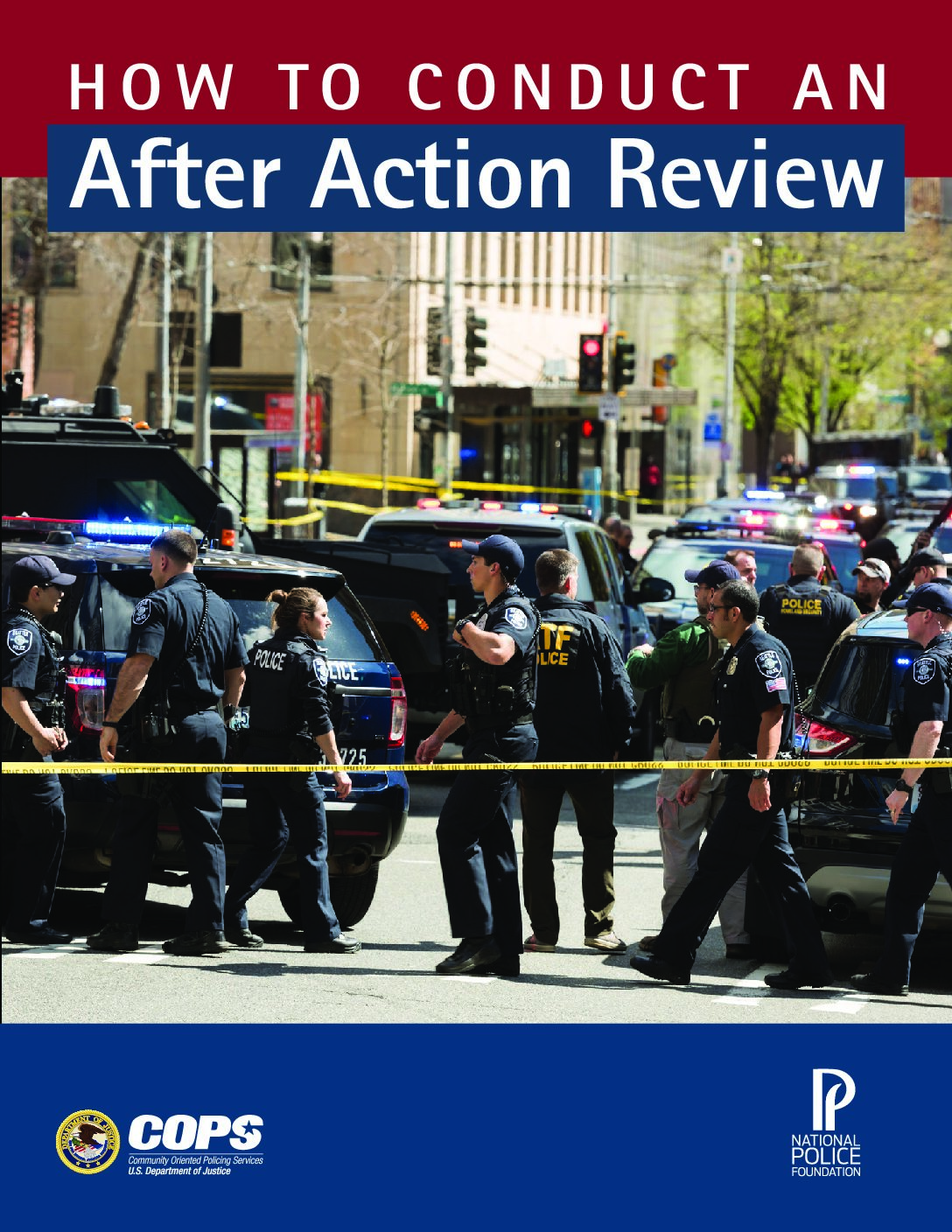
How to Conduct an After Action Review
Publication Date
February 2020
Author(s)
National Policing Institute
Abstract
Some of the most significant changes to law enforcement and public safety responses have emerged from thoughtful, post-incident critical reviews. From the 1999 shooting at Columbine High School to the terrorist attacks on September 11, 2001, after action reviews (AARs) have contributed to vital national-level discussions about strategies and tactics. More recently, the emergency responses to mass demonstrations—including those following the death of George Floyd—have underscored the need for agencies to honestly reflect on past experiences to prepare for future events.
In an increasingly complex operating environment, it is incumbent upon first responder agencies to use every opportunity to identify lessons learned from a department’s response. This guide, developed by the National Police Institute in partnership with the U.S. Department of Justice COPS Office, provides a step-by-step framework for conducting effective AARs that enhance emergency preparedness, incident management, and organizational learning.
What is an After Action Review (AAR)?
An after action review is a team-based process following a critical incident or training exercise. It provides all participants the chance to reflect, share observations, and identify promising practices. The AAR process focuses on discovering what happened, why it happened, and how to sustain strengths while improving on weaknesses.
Importantly, an after-action report is a learning tool, not a mechanism for disciplinary action. By focusing on collective learning and “preventable error,” law enforcement agencies can make changes in critical incident response policy, practice, and organizational culture without assigning individual blame.
The Evolution and History of the AAR
The AAR model has its roots in the U.S. Army, which began regularly conducting these reviews in the late 1970s to adjust warfighting methods after the Vietnam War. By the 1990s, the Army had established the current model for structured team reflection and problem-solving.
The success of this model led other sectors to adopt similar practices and templates:
- Aviation: The NTSB conducts independent investigations into crashes to determine causes and issue safety recommendations.
- Emergency Management: Agencies like FEMA and the CDC often require formal AARs as part of the Homeland Security Exercise Evaluation Program (HSEEP).
- Fire Service: Fire departments use AARs to evaluate problematic incidents and identify responders who may need emotional or mental health support.
- Private Sector: Companies like Harley-Davidson and Jump Associates use the process to refine response team assumptions, inform decision-making, and improve customer experiences.
Why AARs are Essential for Law Enforcement
As Chief (ret.) Rick Braziel famously stated, “law enforcement needs to play chess, not checkers”. Establishing a regular AAR process for both routine and critical incidents helps agencies in several key ways:
1. Preparing for Future Incidents
AARs challenge participants to question previously held assumptions, leading to smarter thinking and more effective execution in the field. For example, after studying AARs from previous events, the Cleveland and Philadelphia police departments implemented “softer” response strategies for the 2016 national conventions, successfully preventing large-scale chaos.
2. Improving Coordination and Communication
AARs identify gaps in incident command and inter-agency communication. Following the Pulse Nightclub attack, a review revealed that while rapid transport of victims saved lives, the trauma center was overwhelmed because they were not notified victims were en route. This led to the development of new communication protocols for future incident response.
3. Fostering Transparency and Public Trust
Including stakeholders and community members in the review process can strengthen relationships and increase accountability. Sharing findings publicly demonstrates a commitment to transparency and helps repair police-community relations after high-profile events.
4. Prioritizing Officer Wellness
Critical incidents can be deeply traumatic. AARs provide an opportunity for debriefings and closure, particularly for those like 911 dispatchers who rarely see the resolution of an event. Furthermore, agencies can use the process to identify the need for long-term wellness initiatives and mental health support.
The 8-Step Guide to Conducting an After Action Review
To ensure a thorough and objective after action report, law enforcement agencies should follow this detailed framework:
Step 1 – Determine the Type of AAR: Decide on the scale (formal vs. informal), scope, and whether the findings will be released to the public or kept for internal use.
Step 2 – Select a Lead or Team: Identify internal or external experts to lead the review. External teams are often preferred for high-profile incidents to ensure objectivity.
Step 3 – Conduct Research: Compile all relevant materials, including social media, body camera footage, dispatch logs, and existing response plans.
Step 4 – Identify and Engage Stakeholders: Conduct interviews and focus groups with responders, victims, and community partners. Use open-ended questions like “Tell us your story” to gather deep insights.
Step 5 – Conduct Analysis: Perform a gap analysis to compare what was supposed to happen with what actually occurred, examining the “why” behind every decision.
Step 6: Develop Findings and Recommendations: Create evidence-based, actionable corrective action items. These should focus on improving future responses rather than assigning blame.
Step 7 – Communicate Findings: Vet the draft report with trusted stakeholders and share the final results through training, roll calls, or public reports.
Step 8 – Implement Lessons Learned: The most critical step is integrating the AAR’s findings into updated policies, training curricula, and emergency operations.
Meta-Analysis: Common Areas of Improvement
A National Police Foundation meta-analysis of 20 major AARs—covering active shooter events, mass demonstrations, and natural disasters—identified recurring themes that every police department should monitor:
- Command and Control: Issues with scene security and uncoordinated self-deployment often add to the chaos of an initial response.
- External Communications: Effective use of traditional and social media is vital for providing real-time information to the public and managing the narrative.
- Victims and Witnesses: Planning for the timely triage and extrication of victims is a frequent area for improvement.
Building a Culture of Learning
Don’t wait for a “big” critical incident to start your AAR process. By conducting regular reviews of routine events—such as use of force incidents or traffic stops—agencies can instill a culture of continuous learning.
After action reports are not just administrative requirements; they are essential for the evolution of public safety. By honestly reflecting on past experiences, law enforcement can anticipate emerging challenges and work collaboratively to protect their communities.
Recommended Citation
National Policing Institute. (2020). How to conduct an after action review. https://www.policinginstitute.org/publication/how-to-conduct-an-after-action-review/

Strategic Priority Area(s)
Topic Area(s)
Contact
For general inquiries, please contact us at info@policinginstitute.org
Share
Strategic Priority Area(s)
Topic Area(s)
Contact
For general inquiries, please contact us at info@policefoundation.org
Share