
Report
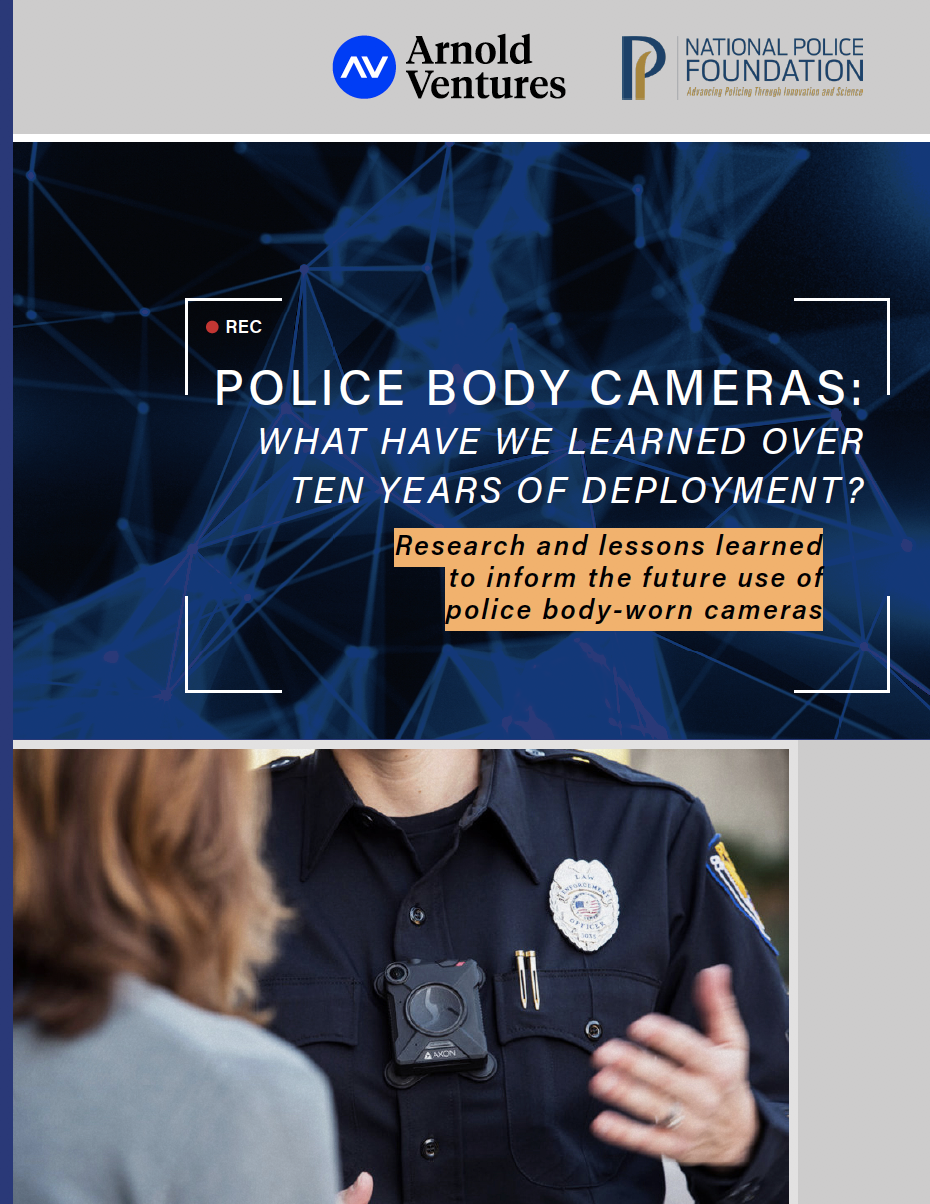
Police Body Cameras: What Have We Learned Over Ten Years of Deployment?
Publication Date
June 2020
Author(s)
National Policing Institute
Abstract
More than a decade has passed since the rapid adoption of police body-worn cameras began transforming law enforcement. What started as a frenetic move toward transparency has evolved into a complex body-worn camera program ecosystem that every police department must navigate.
In partnership with Arnold Ventures, the National Police Institute hosted a forum to synthesize research and practice regarding body-worn cameras (BWC). Here is a summary of what we learned about the technology, its impact on public safety, and the future of digital evidence.

The Impact on Police Officers and Citizens
The implementation of police body cameras was largely driven by the goal of improving criminal justice outcomes and fostering public trust. Over a decade of deployment, research has revealed a complex and nuanced reality regarding how these tools affect both law enforcement and the communities they serve.
Impact on Officer Behavior and Accountability
A primary focus of body-worn camera program research has been its effect on police officers.
- Civilian Complaints: One of the most consistent findings is a significant reduction in civilian complaints filed against officers wearing a bodycam. For example, the Las Vegas Police Department saw a 37% reduction in complaints after implementation. Officers often attribute this to a decrease in “frivolous” complaints, as camera footage can quickly exonerate them by showing a complaint is baseless.
- Use of Force: Findings on use of force incidents are more varied; while some studies show a reduction—such as a 25% decrease in Las Vegas—others show no significant change.
- Professionalism and Training: Many police department leaders use recorded footage for training and audits to ensure compliance with camera policy and officer safety protocols. At the Richmond (VA) Police Department, 73% of officers agreed that wearing a BWC makes an officer act more professionally.
Impact on Citizens and the Community
The community generally views police body-worn cameras as a positive advancement with high expectations for transparency.
- Perceptions of Procedural Justice: Despite the positive general outlook, studies by the Urban Institute and NPF found that simply wearing a camera is not enough to improve a citizen’s perception of “procedural justice”—the feeling of being treated fairly. Instead, public trust is more closely tied to how police officers behave and speak during an encounter rather than whether a camera is present.
- Citizen Awareness: Interestingly, research suggests that many citizens do not even notice the body-worn cameras in real time. In one NPF study, 98% of victims did not visibly react to being recorded by responders, and a large majority were unaware they were being filmed even after being told.
- Specific Populations: Attitudes toward cameras are often less positive among young people and persons of color. Furthermore, while video footage is often requested following high-profile incidents, different stakeholders may subjectively interpret the same body camera footage in radically different ways based on their own biases.
Ultimately, while police body cameras provide a valuable “first-person” record, they are not a panacea. They are most effective when used as a supplement to a robust public safety accountability ecosystem and clear departmental policies.
The Reality of Camera Technology and Infrastructure
Implementing a body-worn camera video strategy involves more than just pinning a device to a uniform. Law enforcement must consider the entire technological ecosystem.
- Camera Technology: Factors such as battery life, durability, and wifi connectivity are critical for daily operations.
- Hardware and Logistics: From the docking station in the sheriff’s office to the mounting location on the officer’s chest, the physical camera technology dictates the quality of the recorded footage.
- Video Footage Limitations: It is vital to remember that camera footage is not an absolute objective record. Factors like field of view and lighting mean that body camera footage does not always capture the full sensory experience or context of an event.
The Hidden Costs of BWC Programs
While the initial procurement of hardware from vendors might seem manageable, the “back-end” costs are often what surprise a police department.
- Data Storage: This is often the single largest ongoing expense, with costs potentially reaching millions as more video recording data is acquired.
- Staffing and Redaction: Managing video evidence requires significant manpower. Agencies must hire staff to handle redaction of sensitive information (such as faces of bystanders or juveniles) before releasing footage to the public or the Department of Justice.
- Legal Mandates: In places like New York, body camera law and state gov regulations may dictate specific retention and release policies that further drive up administrative costs.
Looking Forward: Policy and Accountability
A camera policy alone is not a panacea for criminal justice reform. The report emphasizes that police body cameras are most effective when they supplement a robust, pre-existing accountability structure.
For law enforcement agencies still in the planning stages, the consensus is clear: develop a detailed implementation plan that accounts for both the direct costs of the camera system and the indirect costs of managing a massive influx of digital evidence.
Despite the challenges of pricing and administrative burden, the use of body-worn cameras remains a vital tool for modern policing, providing a level of documentation that was once impossible.
Research Design
Review of research
Research Methods
Literature review
Recommended Citation
National Policing Institute. (2020). Police body cameras: What have we learned over ten years of deployment? https://www.policinginstitute.org/publication/police-body-cameras-what-have-we-learned-over-ten-years-of-deployment/

Strategic Priority Area(s)
Topic Area(s)
Contact
For general inquiries, please contact us at info@policinginstitute.org
Share
Strategic Priority Area(s)
Topic Area(s)
Contact
For general inquiries, please contact us at info@policefoundation.org
Share